
Subjects: Frederick Fowler (b 1869 – d 1951)
Horace Fowler (b 1873 – d 1948)
Researchers: Julia Browne, Heather Turner, Mike Brock, Carol Thompson
After chaotic childhood, two ‘British Home Children’ half-brothers flourish in the U.S.
Frederick and Horace Fowler were two children recorded in the Guildford Union Workhouse in 1881. At first glance, one would assume that these boys were brothers and possibly orphans, but after extensive research, it was clear that their lives and their mother’s extraordinary relationships were far more complex than that. Two years later, they and two other children were the first to be sent to Canada by the Guildford Union as part of the British Home Children Scheme. They were placed with guardians who were expected to give the boys ‘a better life’ – opportunities that Frederick and Horace grabbed with both hands but in completely different ways. Touchingly, they never forgot the woman who was the driving force behind their move to Canada – Guildford Union Board member Augusta Spottiswoode, who they corresponded with for almost 30 years.
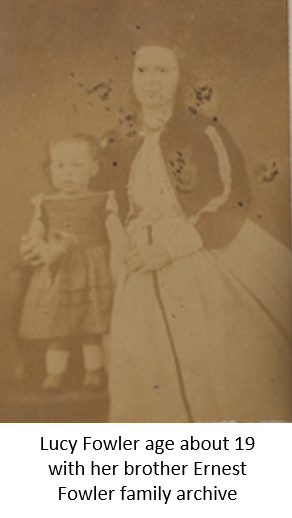 Their mother Lucy’s early years
Frederick and Horace’s mother was Lucy Ann Fowler, born in December 1843 in Stoke next Guildford, Surrey, the eldest child of Charles and Harriett Fowler 1. She was raised by her family in Stoke next Guildford, with the 1861 Census showing 17-year-old Lucy as an unmarried domestic servant still living with her parents in Drummond Road along with six siblings 2.
Frederick born into highly unusual family circumstances
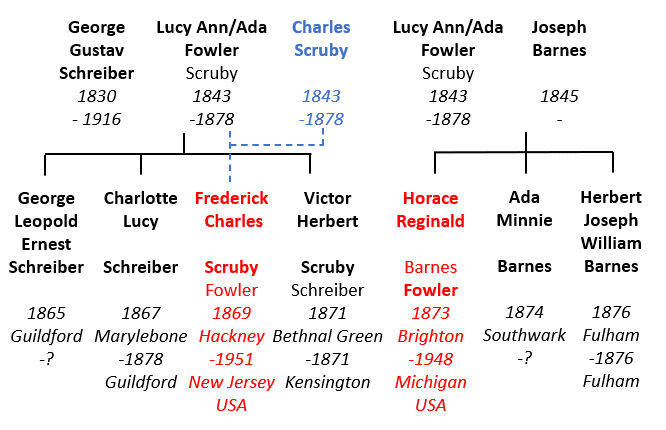
Lucy became a mother at the age of 21 when she gave birth to George Leopold Ernest Schreiber in December 1865 in Chertsey Street, Guildford 4. The father was George Schreiber, a professor of languages from Wurzburg, Bavaria, Germany, some 13 years Lucy’s senior 5.
When she registered the birth a month later, Lucy gave her surname as Schreiber, and her address as Drummond Road, where her parents were living. In truth, Lucy was not married to George Schreiber, as he had married Jane Kemp back in 1856 6.
To complicate matters further, George was separated from Jane and was in a relationship with Sarah Maylin with whom he already had three children 5, 7, 8. Florence, the youngest of Sarah and George‘s children, was born in early 1865 but died later that year in Kensington, London, less than three months before Lucy‘s child George was born in Guildford 8.
Lucy had a second child with George Schreiber, Charlotte Lucy, in October 1867 in Marylebone, London where, according to the birth certificate, they both appeared to be living as a married couple 9.
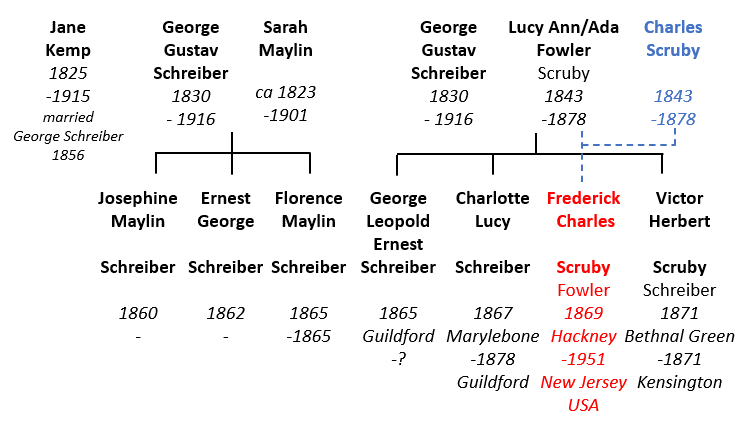 Lucy’s life took another turn when, in October 1868, she married bachelor Charles Scruby, a ‘smith’, in Bethnal Green 10. At first reading of the marriage certificate, she appears to be someone else – she called herself ‘spinster Lucey Ada St Clair’, but later records confirm that she was indeed mother-of-two Lucy Ann Fowler.
Lucy was again pregnant, with Frederick born on 28th February 1869 in Hackney, London 11. According to the birth certificate, his full name was ‘Frederick Charles Scruby’, his mother ‘Ada Scruby formerly Dyson’ and his father, blacksmith ‘Charles Scruby’.
While Lucy’s name was different to that on her marriage certificate, the 1871 Census gives some clarity by showing 27-year-old Lucy Scruby living with her three children at Bethnal Green, but with no sign of her husband Charles 12. She was noted as a ‘married school mistress’, with her children George, Charlotte and Fritz (German version of Frederick), all bearing the Schreiber surname.
Lucy was once again clearly under the influence of Professor George Schreiber, who, despite being back with his wife Jane in Kensington on the other side of London, had already made Lucy pregnant again 13. She gave birth at home in Bethnal Green to their third child Victor Herbert Schreiber in July 1871 14. Lucy adopted the Schreiber surname for the birth certificate, making it appear that she and George were a married couple.
But what of her actual husband Charles Scruby? A trial following the death of Lucy’s newborn son Victor exactly five months later in Kensington, while he was under the care of Sarah Maylin, the mother of George Schreiber’s three other children, would possibly give an answer 15.
‘Baby Farming Extraordinary’
The inquest into the death of Lucy’s son Victor Herbert took place at the Earl of Warwick Tavern in North Kensington just a few days later in December 1871 16. Here Lucy explained that ‘her husband (Charles Scruby) was an engineer’s foreman and was now in America. 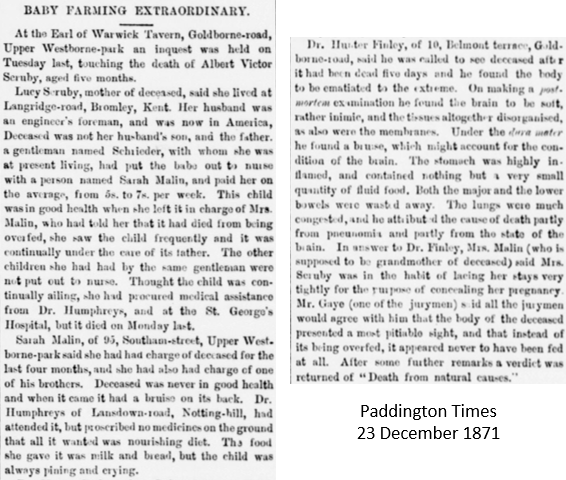 Deceased was not her husband’s son and the father, a gentleman named Schrieder (sic) with whom she was at present living, had put the baby out to nurse with a person named Sarah Malin’.
Lucy added that the ‘child was in good health when she left it in charge of Mrs Malin, who had told her that it had died from being overfed’. However, the doctor who had examined Victor’s body, said that it was ‘emaciated to the extreme’.
Lucy further explained that ‘she saw the child frequently and it was continually under the care of its father’, and that the only reason she had agreed to put Victor out to nurse was because the child was ‘continually ailing’. Sarah Maylin responded, claiming that the child ‘was never in good health and when it came to her it had a bruise on its back’. Sarah added that ‘Mrs Scruby was in the habit of lacing her stays very tightly for the purpose of concealing her pregnancy’.
Despite George Schreiber being the father of Victor as well as five other children of both Lucy and Sarah, the newspaper report made no reference to him speaking at the trial, so it can only be assumed that he was not there.
Dr Huntley, who had carried out the initial examination of Victor, said the cause of death was likely to have been pneumonia and brain damage. A verdict was returned of ‘Death from natural causes’.
Lucy’s husband Charles Scruby
There was some truth in what Lucy had said at the trial – her husband Charles Scruby had gone to the United States but was serving in the U.S. Army at this time, having enlisted in St Louis, Missouri, in August 1870 17. Charles twice re-enlisted for the U.S. Army, leaving for the final time in 1884 18. He moved to Toronto, Canada, with the 1886 City Directory showing him working as a tinner for John. F. Ross, a manufacturer of ‘self-sealing cans’ 19. This continued for about 20 years until in August 1906, Charles was arrested in Toronto for vagrancy 20. Just a few weeks into his six-month sentence Charles died in jail from heart disease, aged 66.
Lucy ‘marries’ again
Following the trial, Lucy’s bizarre relationship with George Schreiber seemed to be over, as in March 1873, she appeared in court again, in Hammersmith, west London, at the trial of plumber Joseph Barnes 21. He was charged with illegally removing stoves and lead piping from two houses in Southerton Road, Hammersmith. Using her married name Lucy Ada Scruby, she 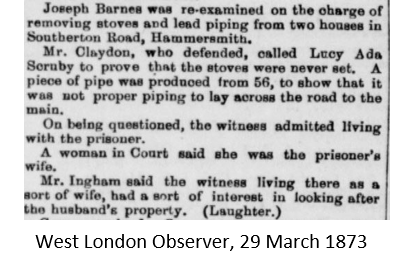 admitted that she was living with Joseph, and, as it later turned out, she was also pregnant with his child. A woman in the court then called out that she was in fact Joseph‘s wife, and not Lucy! The Census from two years prior to this confirmed that this was true – Joseph was married to Louisa and had been living in Southerton Road with their three young daughters, a fourth being born in 1872 22, 23.
Joseph was found not guilty of the charge, but he and Lucy most certainly were guilty of bigamy when they married in Brighton’s St Paul’s Church in May 1873, just a couple of months after the trial 24. They gave 47 Grenville Place, Brighton as their home, with Lucy, using the name Scruby, stating she was ‘widowed’ and Joseph a ‘bachelor’.
Three more children and into Fulham Workhouse
Joseph and Lucy’s son Horace Reginald was born on 25th October 1873 at 12 Upper North Street, Brighton 25. On the birth certificate, Lucy named herself as ‘Lucy Ada Barnes, late Scruby formerly Fowler’ with ‘husband’ Joseph a plumber.
The family had moved to Southwark, south London when their daughter Ada Minnie was born on 2nd December 1874 26. However, any form of stability in Lucy and her family’s life soon disappeared when Lucy and her five children, aged between 10 and one year old, under the name Scruby, were admitted to Fulham Palace Road Workhouse on 27th October 1875 27.
 With George, Charlotte and Frederick of school age, the trio were sent on 4th November to Ashford Poor Law School 16 miles (25km) away in Ashford, Middlesex, a newly built residential school housing 800 children who would otherwise have been in the workhouse 28.
Lucy and the two youngest children, Horace and Minnie, remained in the Fulham Palace Road Workhouse. This situation lasted just 12 days, as George, Frederick and Charlotte were re-admitted to the Workhouse with the family leaving the Workhouse ‘at their own request’ the following day 29, 30.
Where Lucy’s ‘husband’ Joseph Barnes was at this time is not known, but she was again pregnant with his child, giving birth four months later to Herbert Joseph William Barnes on 22nd March 1876 31. He was born at home in Peterborough Road, Fulham. Herbert only lived for three months, dying from phthisis (tuberculosis) at home 32.
By now, Lucy’s health was also poor, as she too was suffering from phthisis. On 4th January 1878, she passed away at Vanston Place, Fulham, aged 32 33. Joseph was there to register the death, giving her ‘married’ name as Lucy Ada Barnes and noting himself as the ‘widower’.
This left Joseph possibly with five children – 12-year-old George, Charlotte (10), Frederick (8), Horace (4) and Minnie (3), although the whereabouts of George and Minnie have not been traced since they left the Fulham Palace Road Workhouse back in November 1875.
Even with only three children, raising them would have been impossible for him while trying to earn a living, so Joseph took the drastic decision to abandon Charlotte, Frederick and Horace at the Fulham Palace Road Workhouse, almost certainly the last time the children ever saw him.
Guildford Workhouse
Shortly afterwards, on 17th January, the Fulham Board of Guardians instructed that proceedings be taken to remove ‘Scruby’s 3 children’ 34. As neither of Lucy’s marriages were legitimate, her home parish fell under the Guildford Union and, under national rules, they would be responsible for her children’s care 35. In April 1878, three months after their mother’s death, Charlotte, Frederick and Horace were accepted by the Guildford Union Workhouse following an ‘…Order of Removal from Fulham Union of 3 illegitimate children of Lucy Ann Fowler alias Schruber (sic) alias Scruby alias Barnes, now deceased and whose settlement appeared to be in Stoke (Next Guildford)’ 36. One small positive in this desperately bleak situation for the children was that they would be living near to the home of their maternal grandmother Harriett Fowler.
Charlotte, Frederick and Horace were now full-time inmates of the Guildford Union Workhouse and would have attended school there. Charlotte died aged 11 from tubercular meningitis in December 1878, less than eight months after their admission, leaving behind half-brothers 9-year-old Frederick and Horace, 5 37.
By the time of the 1881 Census, the boys had spent about three years in the Guildford Union Workhouse, undoubtedly the longest time they had spent in any one home 38. That Census also showed that Horace’s father Joseph Barnes, who had left the boys in the Workhouse, was back with his wife Louisa and their four daughters, living in Torquay, Devon 39. In August 1883, Joseph, his wife and daughters emigrated to Australia 40.
Fred and Horace sent to Canada
Just two months before their father’s emigration, Fred, as he was generally known, and his half-brother Horace were heading in the opposite direction for another part of the Commonwealth – Canada.
For some time, there had been discussions amongst the Guildford Board of Guardians about a somewhat controversial idea to send selected orphan and pauper children to live in Canada with foster families. This was a national scheme known as ‘British Home Children’, first sending children in 1869 41. Guildford Board member Miss Augusta Spottiswoode, one of the first women in Britain to hold such a position, was a strong supporter of the scheme, saying ‘The openings for children, and especially girls, are much more advantageous (in Canada) than in this country; and in many cases it is good for the children to be taken out of the way of relations, who often wish to regain a hold on them as they become of an age to earn money’ 42.
Correspondence from Miss Spottiswoode to Horace written over 20 years later still survives, in which she said that the boys’ maternal grandmother, Harriett Fowler, had been consulted about their move, with Augusta writing: ‘I well remember your grandmother and how anxious she was that you should not go to Canada unless Fred went with you’ 43.
In 1883, The Board decided that the first group of four children to be sent from Guildford to Canada would be 14-year-old Fred and Horace, only 9, together with Alice and James Hart. The Board of Guardians chairman Mr EJ Halsey said that ‘the children were exceedingly happy and felt a pleasure in thinking about what was to happen to them’ 44.
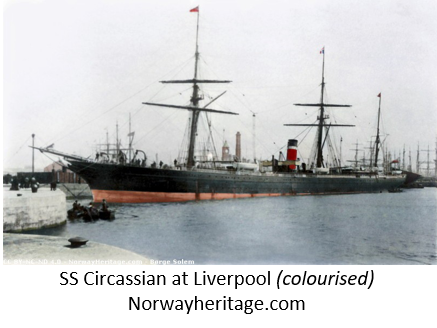 On 7th June 1883, travelling with a group of over 100 children from workhouses around the country led by John T. Middlemore, founder of the Middlemore Children’s Emigration Homes, Fred and Horace departed Liverpool on SS Circassian, heading for the Middlemore Receiving Home, Guthrie House, in London, Ontario 45.
Fred and Horace separated
Despite Fred and Horace being half-brothers, they were sent from Guthrie House to different foster parents in the 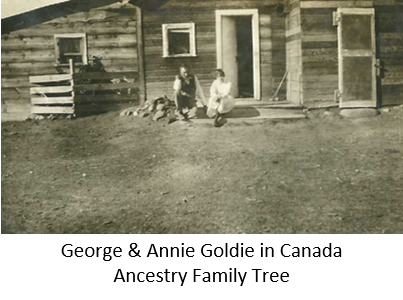 Ontario province.
Fred was placed with Scots George R Goldie and his wife Annie in Mooretown, Ontario on the United States’ border, about 68 miles (110km) west of Guthrie House 46.
Horace, meanwhile, was sent to a far more remote part of Ontario, 225 miles (365km) north-east of Guthrie House, to live with English farmer George William Sibbett in Ullswater, Muskoka County 47.
Early the following year, in January 1884, Miss Spottiswoode received a letter from Fred in which he had told friends ‘that he was getting on very well and that Horace, who was sent out by the Board, was getting 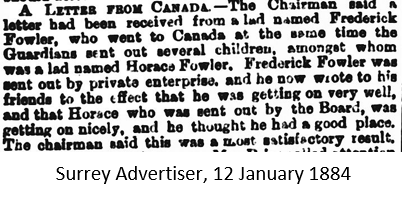 on nicely, and he thought he had a good place’ 48. The Chairman of the Board of Guardians, Mr EJ Halsey, who had authorised their emigration, said ‘this was a most satisfactory result’.
Fred
Less than a year after arriving in Canada, Fred decided to move to the United States. 15-year-old Fred travelled by train in May 1884 via Niagara Falls some 600 miles (960km) south-east to Philadelphia, Pennsylvania 49.
What became of Fred in his early time in the United States is unknown – the 1890 U.S. Census was almost completely destroyed in a fire at the Washington DC archives in 1921 50. However, a letter written in June 1896 by Fred’s grandmother Harriett Fowler to his brother Horace showed that Fred may have been living in St Louis, Missouri 51. Harriett wrote that she had heard about a tornado that had killed 255 people in the city in May 1896, telling Horace: ‘I ain’t had no rest night or day thinking of it…Be sure and find Fred if he is alive’.
Another letter from Harriett to Horace six months later revealed that Fred was most certainly alive, as he had just returned to Guildford to see her 52. Harriett wasn’t totally happy with the visit, however. She wrote: ‘There is nowhere for him to stop here (63 Drummond Road, Guildford) only for a day … I have got no home to come to, only my own room’. Harriett also mentioned that Fred was looking for his missing half-sister Minnie but added: ‘I don’t think for a minute he will find her’. This appears to have been true, as no further record for Minnie since she left the Fulham Workhouse in 1875 has been found.
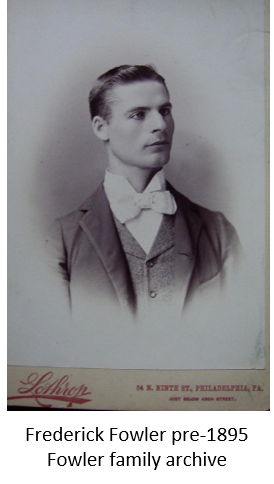 Fred returned to the United States on 16th December 1896, arriving in Philadelphia 12 days later 53. Noted as a ‘gentleman’ and travelling by ‘second cabin’, Fred was going to St Davids, Delaware County, about 15 miles (24km) west of Philadelphia. A portrait photograph of Fred taken at a studio in Philadelphia is probably dated pre-1895 as the studio had moved from there by then, so it would seem Fred had been living in the Philadelphia area for some time.
Fred settles down
In June 1904, Fred was in Camden, New Jersey where he married Emma McKeever, from Philadelphia 54. Camden was no great distance from Philadelphia – just a short ferry ride across the Delaware River separated the two cities and states. Emma was a 30-year-old piano teacher who was clearly good at her job 55. An article from the Camden Courier Post back in February 1894 told of Emma and her pupils staging a musicale in Camden with ‘special mention made of the vocal solo rendered by Miss McKeever’ and that she also ‘favored the audience with some very fine piano solos’ 56.
B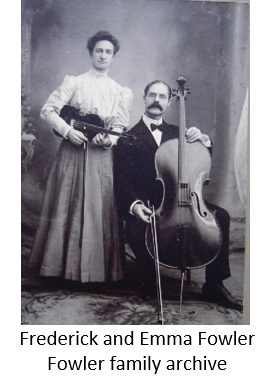 ut what of 35-year-old Fred? The 1905 New Jersey Directory gives the answer – he was a piano tuner! 57 Whether this was the way they met cannot be confirmed – no records have been found to indicate how or when Fred came to be a piano tuner, nor did advertisements in the newspapers and local directories appear for him as a piano tuner until after they were married. Family photos show that Fred had also become a musician, posing with a banjo in one and then, in a later picture, with a double bass alongside his wife Emma who was holding a violin.
By 1910 Fred and Emma were settled at 822 State Street, Camden, still in their respective professions but with no children 58. The 1920 Census stated that they owned and had paid off their house in State Street, so they had a good income, even though Emma appeared to have stopped teaching by this time 59.
By 1930, they had moved to the suburbs of Camden at Pennsauken. They owned this property too, valued at 6,000 USD, and again only Frederick was working 60. This Census also noted them as having a ‘radio set’, national broadcasting having commenced in the U.S. in the early 1920s.
Fred becomes a U.S. citizen
O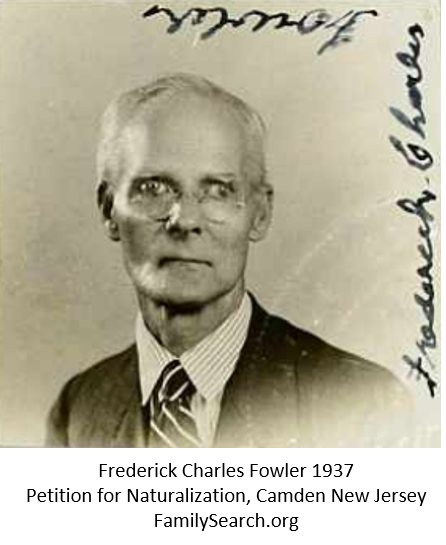 n 1st April 1937, Fred applied to become a naturalised citizen of the United States, almost 53 years since he had crossed the border from Canada 61. The form showed his sketchy early knowledge – his birthdate was wrong and he gave his place of birth as Guildford, not Hackney, although having spent a number of years in the Guildford Union Workhouse, that is maybe not a surprising error. On a Social Security record two years later, Fred named his parents incorrectly too, although ‘Charles Fowler’ and ‘Ada Barnes’ showed that he had some idea of the chaotic mix of names he had been involved in 62.
Fred and Emma were still living in 43rd Street in 1940. By now Fred, in his 70s, was having trouble with his piano tuning business and was seeking work 63. Emma, 65, had gone back to music teaching.
After over 46 years of marriage, Fred passed away on 4th January 1951, aged 81 64. Emma died in May 1961, also 81 65.
Horace
It was not just Fred but Horace too who, as a teenager, left Canada for the United States. The letter that Fred had written to Miss Spottiswoode at the Guildford Union back in 1884 saying he believed Horace was in ‘a good place’ was not true. Family lore said that he had ‘been required to live in a barn, not been allowed to eat with the family, not allowed to go to school and to have been beaten’. Horace ran away and was taken in by Henry and Sarah Elizabeth Gornell, an English couple from Yorkshire living in Muskoka Lakes 66, 67, 68.
In 1887, 14-year-old Horace’s foster parents decided to emigrate, taking Horace and their three other fo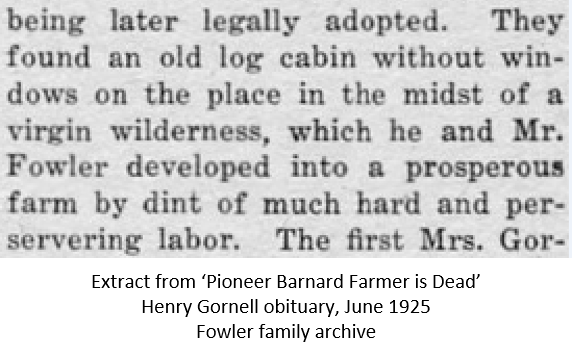 ster children due west, crossing Lake Huron into the United States. They settled in rural Barnard, a few miles from Charlevoix, on the shores of Lake Michigan. Horace clearly flourished in his new environment, and at the age of just 20, he opened a meat market in Charlevoix in 1893 66.
Two years later, on 23rd October 1895, a couple of days before his 22nd birthday, Horace married 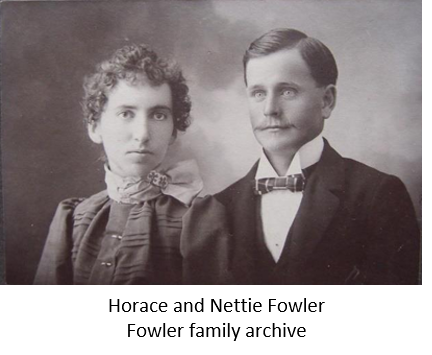 Canadian-born housemaid Nettie Shrier, aged 19 69. On the marriage register, Horace’s father was given as ‘R Fowler’ and his mother’s name left blank. Horace was only 4 years old when his mother Lucy Ann Fowler died and when he probably last saw his father Joseph Barnes, so everything he knew about his early childhood would have come from his half-brother Fred, which, as has been shown, was somewhat confused.
Horace and Nettie had a son Forrest Frederick in October 1899, named no doubt after his half-brother 70. The family remained in Charlevoix, with the 1900 Census noting them living in Lincoln Avenue with Nettie’s family. Horace was still running the meat market as a ‘meat-cutter’. The business was clearly doing well, as about five years later, Horace bought a plot of land in Antrim Street, Charlevoix and built a house with the help of his father-in-law, John Shrier, who was a carpenter 71.
Letters from England
The house, number 214 Antrim Street, remained in the family for generations, where some letters written to Horace by Miss Augusta Spottiswoode, the member of the Guildford Union Board of Guardians who had been instrumental in Horace and Fred’s emigration to Canada back in 1883, had survived.
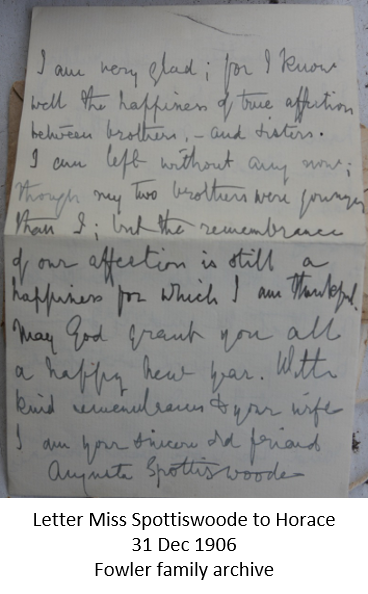 The first letter was dated 31st December 1906 and clearly showed that Horace and Augusta had long been corresponding as she thanked Horace for his Christmas card and gift, a ‘very pretty book of illustrations of that beautiful Hymn Rock of Ages’ 72. Augusta, an 83-year-old spinster, lived in Shere, Surrey, and had been retired for many years, but was still exchanging letters and gifts with both Horace and Fred. Augusta knew that Fred and Horace kept in touch with each other – ‘He tells me that he and you keep up a good correspondence, and that he hopes to go and see you next summer. I am very glad; I know well the happiness of true affection between brothers …’, she wrote.
Despite Augusta’s age and failing health, she continued to correspond. Sometimes she needed her niece to write the letters for her, although Augusta still signed them. In one of the letters, Augusta reminisced about her times with Horace and Fred back in Guildford – ‘Do you remember the walks that we sometimes had on the top of the Downs? Perhaps you do not, as you were so young; but Fred would’ 73.
Augusta’s final letter to Horace was written on 18th June 1912 in which she asked him if he had heard anything from James Hart, the other boy who with his sister Alice had travelled to Canada with Horace and Fred back in June 1883 74. Just six weeks after posting the letter, Augusta passed away aged 88, ending a remarkable relationship between her and the children she had worked so hard to give a better life to 75.
Horace moves up
Horace and Nettie had become naturalised U.S. citizens in 1910 76. In August 1914, the Great War, eventually to become known as World War 1, began. The United States did not enter the conflict until April 1917, and in September 1918, despite being almost 45 years old, Horace had to register for military service 77. Horace was now running a garage, Erickson & Fowler Co with his business partner, and was described on his registration as being of medium build and height with blue eyes and brown hair 66, 78. Horace clearly did not know his own birthdate, however – he said he was born on 1st October 1873, the actual date being 24 days later. The war ended with the Armistice just two months after Horace registered, so it seems unlikely that he ever became involved.
Horace and Nettie continued living at 214 Antrim Street after the war, and Horace remained a garage proprietor and employer. He also set up bus and taxi services to nearby towns and cities 71. Their son Forrest had married in 1919 with the Census the following year showing him living with his wife across the road at number 211 79, 80.
Ten years later, Horace and Nettie’s situation remained much the same. The 1930 Census gave the value of 214 Antrim Street as 2,500 USD with Horace and Nettie, like his half-brother Fred in Camden, owning a ‘radio set’ 81, 60. Another similarity with Fred was that Horace had a musical talent too, being the tenor soloist of Charlevoix’s Congregational Choir 66.
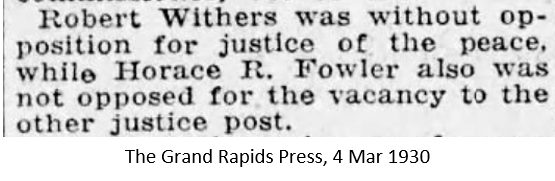 What 56-year-old Horace did not mention on this Census was that a few weeks earlier, he had been appointed ‘not opposed’ as a Justice of the Peace for Charlevoix, a remarkable achievement for someone from such a difficult and unstable beginning to his life 82.
By 1940, Horace had retired from his garage business but was still a Justice of the Peace at Charlevoix’s City Hall 83. He had been in this role for almost 20 years when he passed away on 9th July 1948, aged 74 84. His wife Nettie remained alone at 214 Antrim Street before moving to their son Forrest’s house in 1955, where she died in September 1956, aged about 80 85.
Postscript
Fred and Horace’s lives were undoubtedly transformed by Augusta Spottiswoode convincing the Guildford Board of Guardians to send the boys to Canada, although both chose as teenagers to move to the United States. Whether the boys would have lived such fulfilling lives if they had remained in England can never be known, but it is worth noting that James Hart, who left Guildford for Canada with Fred and Horace in 1883, also achieved success in the United States.
However, like Horace at the beginning, not everyone sent to Canada was so fortunate, with the Home Children schemes coming in for much criticism, including from within the Guildford Board of Guardians 86, 87. In 1885, Board member Aaron Wells stated that he was ‘strongly averse’ to sending children. He reasoned that ‘if the Board would have called them in and saw for themselves how small and helpless they were, they would feel the same aversion to sending them so far away’. Indeed, in 1887, the Guildford Board of Guardians were called out for sending two children to Canada who were physically unfit for emigration 88.
In 1891, the Canadian Government announced that it would investigate criticism ‘that children sent to Canada from England are street waifs and workhouse paupers, and that the professional philanthropists engaged in the work are largely prompted by mercenary and not charitable motives’ 89. It was certainly true that the cost of sending a child was far cheaper than that of keeping them in the workhouse 90.
The last record traced for the Guildford Board of Guardians participating in the ‘British Home Children’ scheme was in 1903, although it was not until 1948 that the scheme ended after an estimated 100,000 children had been sent from Great Britain to Canada 91, 41.
February 2023, updated November 2026
Edited by Mike Brock
We are very grateful to Philina English, great great grandaughter of Horace Fowler, for sharing with us invaluable contributions in the form of family stories, press clippings, and personal letters.
We’d love to hear from you if you enjoyed this biography, and especially if you if you know what happened to Minnie Fowler (Barnes), sister of Fred and Horace, or to their brother George Leopold Ernest Schreiber (Fowler)
 Contact us by email at spikelives@charlotteville.co.uk
Facebook at Tales from Guildford Workhouse Instagram at GuildfordSpikeLives
More biographies about Guildford Union and British Home Children in Canada
- William, Harriet and Catherine Cates: Imprisonment then Workhouse for Royal Marine, but better fortunes for his daughters
- Henry, William, Alice and James Hart: Groundbreaking Hart family make Guildford Union proud
- Rose, George, Ellen and Eliza Hebburn: Abandoned children given new start in Canada
- Mary Ann Joyce and Walter Shires: Stark contrast in half-siblings’ lives
- Miss Augusta Spottiswoode: the “Children’s Friend”
Sources and References
Original Surrey parish and Guildford Union records are available at the Surrey History Centre, Woking. Digitised records were sourced through Ancestry.co.uk and Ancestry.com /Newspapers.com. A complete list may be found at Frederick and Horace Fowler references
 Spike Lives is a Heritage project that chronicles the lives of inmates, staff and the Board of Guardians of the Guildford Union Workhouse at the time of the 1881 Census. The Spike Heritage Museum in Guildford offers guided tours which present a unique opportunity to discover what life was like in the Casual/Vagrant ward of a Workhouse. More information can be found here