
Subject: Henry Portsmouth (b 1843 – d 1895)
Researcher: Lesley Hall
RELIEVING OFFICER FOR THE GUILDFORD UNION 1871 – 1895
A Victorian social worker with a myriad of roles
From humble beginnings, ambitious Henry Portsmouth changed from carpentry to become the Relieving Officer for Woking and then Guildford, the largest parish of that Union. He took on almost every role that the Guildford Union Board of Guardians threw at him, saving them money where he could, but making sure that he himself was properly remunerated.
In today’s terms, his role as Relieving Officer combined those of social worker, environmental health officer and schools truant officer to name a few of his many tasks. He would have had to have been fair yet compassionate and clearly had an excellent grasp of the Poor Law and how to apply it.
Many of Henry’s cases were reported in graphic detail in the local press, putting him constantly in the public eye. His early death was perhaps not helped by the stresses of his position and was ‘a very great blow’ to his employers, the Guildford Union.
Early life
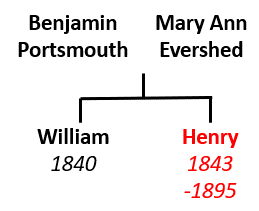 Henry Portsmouth was born on 18th March 1843 in Shalford, situated between Guildford and Godalming, and baptised at the village’s St Mary the Virgin Church in April that year 1, 2. He was the son of Benjamin, a leather tanner, and Mary Ann née Evershed, and was brought up in Shalford with his elder brother William 3. Henry became a carpenter, living in the village until moving to Guildford shortly before his marriage 4.
Marriage and family
On 20th September 1863, at the age of 21, Henry married 26-year-old Jane Champion from Ewshot, at Crookham on the Surrey-Hampshire border 5. Prior to the marriage, Jane had been a house servant for a grocer in Guildford 6.
Henry and Jane’s first son, William, was baptised in March 1864, at St Mary’s Guildford, when they were living in Castle Street 7. By the time daughter Emily Florence was born two years later, the family had moved to Stoke next Guildford 8.
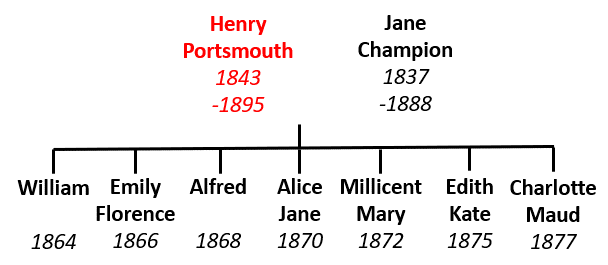 In 1871, Henry and Jane were at Joseph’s Lane (now Joseph’s Road), with four young children – William (7), Emily Florence (5), Alfred (2) and Alice Jane (7 months) 9. Their home was close to the St John the Evangelist Church where all their children bar William would be baptised 10. It was also the church where many of the baptisms of Guildford Union Workhouse inmates took place. Three more daughters followed to complete the family.
From Carpenter in Guildford to Relieving Officer in Woking
Henry’s fifth child, Millicent Mary, was the only one of his children not born in Guildford. She was born in Woking in 1872, as her father had taken a very different new job and needed to re-locate to that parish 11.
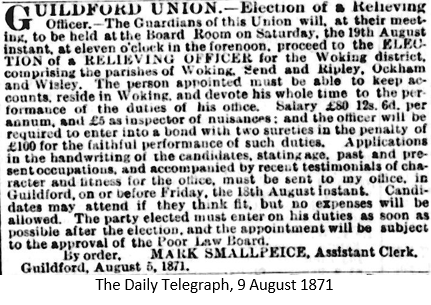 This had come about in the summer of 1871 when Henry had applied to become Relieving Officer for the Woking district of the Guildford Union, after the current incumbent Mr Potter had transferred to the larger Guildford district 12.
Henry must have impressed the Board of Guardians, as after the 16 original applicants were whittled down to two, Henry was appointed by twelve votes to nine 13. He was required to ‘keep accounts, reside in Woking, and devote his whole time to the performance of the duties of his office’ 14.
This change was quite a step up from his job as a carpenter with much more responsibility and being part of a team. With a fixed starting salary of over £85 per year, he now also had a steady income and opportunity for progression.
 What was the work of a Relieving Officer like?
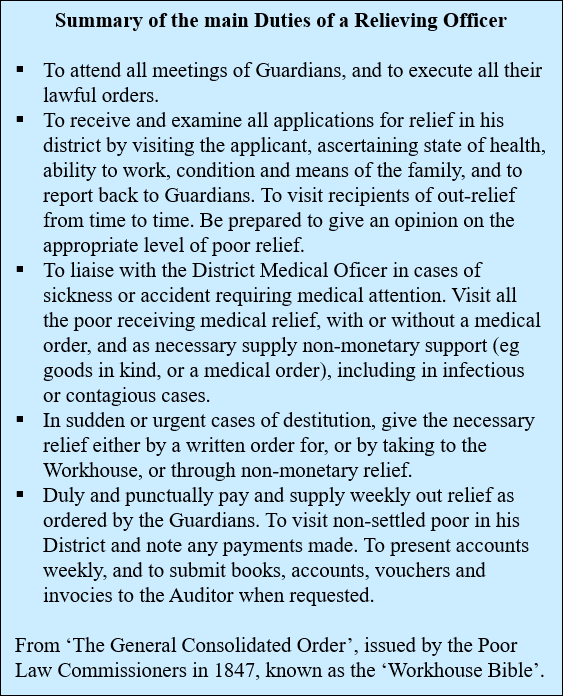
The ‘Duties of a Relieving Officer’ had been set out by the Poor Law Commissioners in the 1847 Consolidated General Order, known as the Workhouse bible, naming 16 main duties running to over seven pages of instructions 15.
To follow these guidelines, Henry would have needed to have built up an in-depth knowledge of the poor in his district, worked closely with the District Medical Officer, and fill in a very large number of forms – not dissimilar to today’s social workers.
Promotion to Guildford district
Almost three years later, in April 1874, the Relieving Officer for the Guildford district Mr Potter, who had been Henry’s predecessor for the Woking District, fell ill 16. The Board of Guardians initially appointed a temporary Relieving Officer, Mr Higgins, as cover 17. However, following the death of 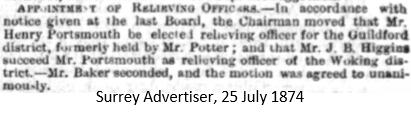 Mr Potter in July, the Guardians unanimously agreed that Henry be appointed Relieving Officer for the Guildford district, and that Mr Higgins should replace Henry as the Woking Relieving Officer 18, 19.
This took a while to happen as the Local Government Board, overseers of all Unions, were slow in approving these appointments. The delay was somewhat beneficial for the Guildford Union Board as Henry had not yet succeeded in finding a house in Guildford, a requirement of the job 20. Henry and his family eventually moved to 2 Upfold Buildings, in Markenfield Road, Stoke Next Guildford, about a mile from the Workhouse 21. The two gentlemen were confirmed in their posts as Relieving Officers and Inspectors of Nuisances by late August 1874 22.
Was Henry’s move to Guildford good career-wise and financially?
Back in 1871, when Henry’s predecessor, Mr Potter, had requested the move from Woking to Guildford, the Chairman of the Board of Guardians, Francis Scott, had described Guildford as being a ‘larger sphere’ than Woking, and the office of Relieving Officer there as ‘not one of the highest in the Union, but the duties were of an exceedingly arduous character, and required in their discharge the exercise of discretion and discrimination’ 12. Henry’s move from Woking to Guildford was therefore a clear promotion, for which he was paid accordingly.
Inspector of Nuisances
The role of Inspector of Nuisances had been formally included in the Guildford Union Relieving Officers’ remit in 1873. It was taken on by Henry and his fellow Relieving Officers somewhat grudgingly, noting that ‘the extra duties involved would be more than they could discharge, but if the Board thought fit to cast the duties upon them, they would do their best’ 23. The work carried an additional salary of £5 per annum.
There was some cross-over as an Inspector of Nuisances, because Relieving Officers already worked with Medical Officers on housing conditions and illness, but now Henry had much more to deal with in his new post – the threat of typhoid caused by poor housing drainage and sewage systems, unfit foodstuff cases, decomposing animals in slaughterhouses and tracing people who had been in contact with infectious diseases – what we would today call Environmental Health Officers 24. Despite all these threats to his own health, Henry does not appear to have contracted any disease.
In 1881, the Local Government Board insisted that the Union appoint one separate Inspector of Nuisances to cover the whole Guildford Union area, thus removing the role from Henry 25.
The worst of poverty
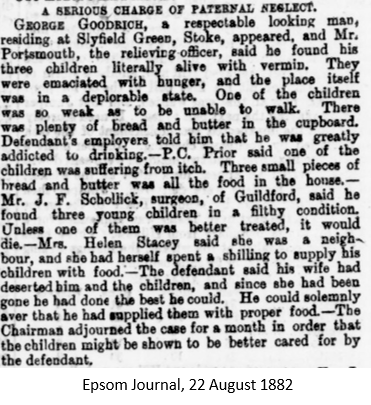 As well as the day-to-day work of distributing poor relief to the needy, Henry had to deal with the awful consequences of dire poverty – desperate hunger, physical abuse and violence, the abandonment of children. For example, in 1882 George Goodridge was taken to court for ‘paternal neglect’ 26. Henry attested that he had found Goodridge’s three children ‘literally alive with vermin’, ‘emaciated with hunger’ and the home in a ‘deplorable state’. George was found guilty of ‘scandalous neglect’ and sentenced to 14 days imprisonment with hard labour 27.
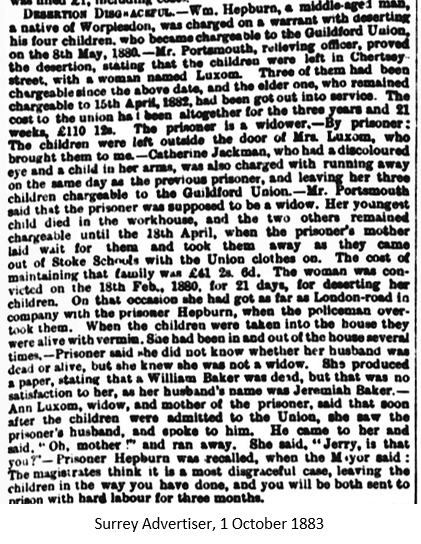
One of the worst cases handled by Henry was the shocking abandonment of seven young children from two Guildford families in 1880 which caused a public outrage.
The guilty parents were William Hebburn and Catherine Jackman who, after running away together, were to evade the authorities until October 1883.
Henry once again was called to court to testify, leading to gaol sentences for both William and Catherine.
Henry digs in his heels against the Board
Henry, as a Relieving Officer and Inspector of Nuisances, was also called upon to be the district Vaccination Officer, responsible for ensuring that all children born in his area received a compulsory smallpox vaccination, carried out by the district Medical Officer, and for chasing up parents who did not comply 28.
However, Henry was not so willing when, in September 1877, the Guardians looked to add the duties of School Inquiry Officer to him 29. This would have made him responsible for ensuring school fees were paid by parents who were not officially paupers but ‘poor’, either by their own means or with assistance from the Union 30. While other local Relieving Officers agreed to this, Henry refused point blank to accept the appointment, despite extra remuneration, saying he could not carry out the duties ‘unless able to have a horse and trap when required, his time being already fully occupied’. The Guardians accepted his refusal, and a fellow Relieving Officer took on Guildford’s caseload 31.
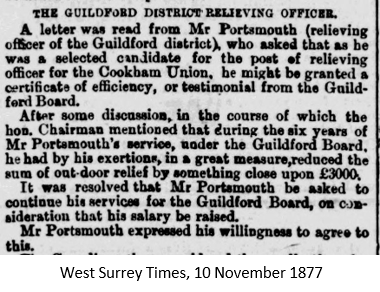 Despite this, or perhaps because of this, Henry applied a couple of months later for a more lucrative job with another Union. However, the Board of Guardians were reluctant to lose him 32. In addition to his experience, through his detective work, and knowledge and application of the Poor Law, Henry had been able to save the Union considerable amounts of money by, for example, locating errant husbands and tracing relatives to contribute to the maintenance of paupers in the Workhouse 33.
The Chairman noted that during Henry’s six years as Relieving Officer for Guildford, he had reduced expenditure on outdoor relief by almost £3,000, around £300,000 in today’s money October 2025, 34. In the end, Henry agreed to stay on with the Guildford Union, with another increase in salary.
Henry takes on yet another role
Despite Henry’s initial refusal to accept being the School Inquiry Officer, in March 1879 he eventually agreed to take it on when the Board of Guardians combined that role with that of Schools Attendance Officer, adding to the duties of their Relieving Officers 35.
As well ensuring that school fees were paid, this involved going into schools to obtain the names of children who had not attended, visiting the parents’ homes to determine the circumstances, and issuing notices and warnings for children who attended irregularly. Henry was offered an extra £40 a year for ‘travelling purposes’, no doubt ensuring that he could afford this time to have a horse and trap on hand when needed.
An example of the cases investigated by Henry was that of Francis Faggetter who lived  through a childhood of domestic violence perpetrated by his father Edward against his mother, no doubt influencing Francis’s truancy from his school in Pirbright in 1879 36.
Home move
Around this time, Henry and his family moved around the corner from Joseph’s Lane to Stoke Road, between the Stoke Hotel and the Prince Albert Inn 37. The 1881 Census listed Henry, now aged 38, as Relieving Officer, Vaccination Officer and Schools Attendance Officer, living in Stoke Road with his wife Jane and six of their children aged from 15 down to 4 38.
Relentless life for Henry
Although by now Henry was no longer the Inspector of Nuisances, his three remaining roles still involved constant travel around the district, so he was not always available when people wanted to contact him.
His journeys included accompanying mentally ill paupers and inmates to the Brookwood Asylum near Woking, a round trip of about 15 miles (24km) from the Guildford Workhouse 39.
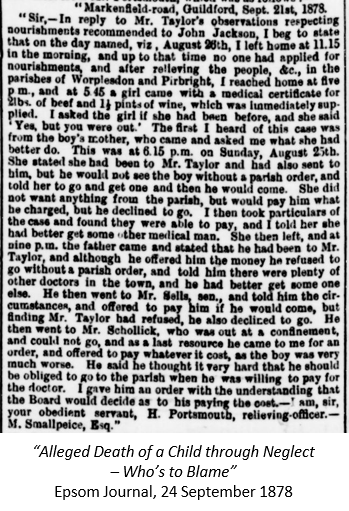 Henry also had to chase around ensuring official orders were applied for and then received, causing difficulty and confusion in the execution of his duties which sometimes led to disagreements with other officials and complaints being made 40.
Henry’s burden was somewhat eased in April 1884 when he resigned as School Attendance Officer ‘as he does not consider the remuneration adequate’, although he remained as School Inquiry Officer until the post was abolished after the 1891 Education Act made primary education free for all children 41, 42, 43.
Henry’s wife Jane passes away
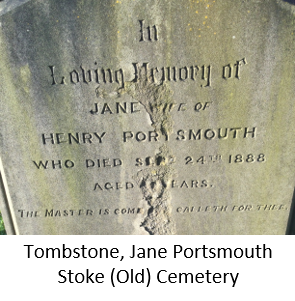 On 24th September 1888, Henry’s wife Jane, after 25 years of marriage, died at their home in Stoke Road, age 49 44.
The funeral service was led by the Curate of the family church of St John the Evangelist, with Jane buried in Stoke Cemetery 45, 46.
Henry asks for a pay rise
Six months after his wife died, the Guardians discussed a letter from Henry requesting a salary increase 47. Henry stated that he had ‘held his appointment since 1871 and had never applied for an increase although the population and his work had largely increased’.
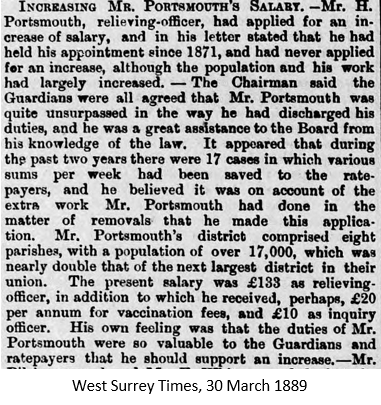 The Guardians agreed that ‘Mr Portsmouth was quite unsurpassed in the way he had discharged his duties, and he was a great assistance to the Board from his knowledge of the law’. The Chairman described how extra work Henry had performed during the previous two years on removals (sending inmates back to their legal place of settlement 48) had saved rate payers significant sums of money in his district of eight parishes, with a population of over 17,000 people. They decided Henry’s services were so valuable that his salary should rise from £133 to £150 per year.
Temporary Master of the Workhouse – twice
In July 1890, the Guardians asked Henry to be temporary Master of the Guildford Union Workhouse until the newly appointed Master and Mistress could start, the previous incumbents having resigned 49. The Board clearly saw Henry as a safe pair of hands. The Local Government Board approved this in August, and in October the House Committee recommended a gratuity of £10 10s (£10.50) be paid to him for the extra services rendered.
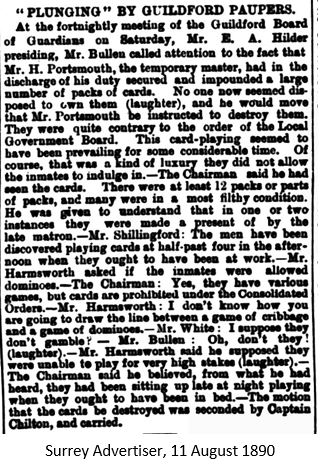 During his short time as temporary Master, and knowing well the rules, Henry impounded a large number of packs of playing cards, being used by male paupers contrary to Local Government Board regulations – ‘a kind of luxury they did not allow the inmates to indulge in’ 50.
Men had been found playing cards in the afternoon ‘when they ought to have been at work’ and late at night ‘when they ought to have been in bed’. Apparently, dominoes were acceptable, whereas card games were not, so the cards were destroyed.
The following year, in Spring 1891, the new Master fell ill, and dependable Henry was again asked to step in temporarily 51. Henry filled in until the end of May, for which he was awarded a gratuity of £10 plus £2 18s (£2.90) for out-of-pocket expenses incurred as a consequence of his increased duties for ‘services rendered by him in assisting management of the workhouse during the 9 weeks in which the master was incapacitated by illness’.
43 Stoke Road (also called 2 Fawcett Villas) was still home for Henry and family at this time 52, 53. Four of his children remained with him – daughters Emily, Alice, Edith and Charlotte.
Henry’s address would have been well-known by the poor of the district, which sometimes gave rise to unwanted intrusions and disturbances. In December 1893, a labourer Charles Sherlock called at Henry’s home asking for a pass into the Guildford Union Workhouse, claiming he was ‘out of work and had nothing to eat all day’ 54. Henry realised Charles was drunk and refused to grant the request, whereupon Charles threw a stone through a window of Henry’s house. Pleading guilty, Charles was sentenced to a month’s gaol with hard labour.
Sudden Death
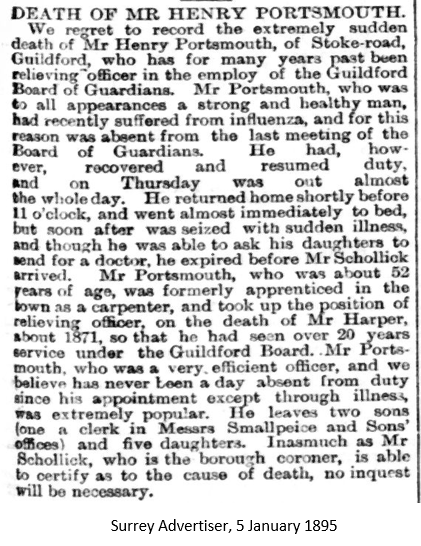 Henry was still working for the Guildford Union as Relieving Officer when, on 3rd January 1895, he died suddenly at home, aged 51, after a bout of flu and ‘failure of the heart’s action’ 55. He had been a Relieving Officer for Woking and then Guildford for over 23 years, and according to the Surrey Advertiser ‘was extremely popular’ 56.
The funeral was conducted by the vicar of St John the Evangelist at Stoke Cemetery on 9th January, with Henry being buried near his wife Jane 57, 58. It was attended by, amongst other district officers, the Chairman and two members of the Board of Guardians 59. The Guildford, Hambledon and Farnham Poor Law Officers’ Association sent a wreath of tea roses.
Henry’s death was sincerely regretted by the Board of Guardians. The Chairman described him as ‘one of their most able relieving officers’ who ‘had carried out his duties admirably. He succeeded in satisfying both the Board and the ratepayers, and his death was undoubtedly a very great blow to the Board’ 60. The Vice Chairman said that ‘in Mr Portsmouth they had an officer on whom they could thoroughly rely, both in his knowledge of the Poor Law, and the way in which it should be carried out’ and added that ‘Mr Portsmouth had done his duty thoroughly well for more than 20 years’ 61.
His hard work had left Henry comfortably off with effects of £434, quite a considerable sum, equating to around £50,000 today (September 2025) 62, 63.
Henry Portsmouth was undoubtedly a major force in the work and running of the Guildford Union. Unlike many members of the Board, Henry came from an unprivileged background, giving him a natural understanding and empathy with the hardships and problems of the ordinary people. He was clear in his objectives, being both honest and fair, and was able to communicate and operate successfully at all levels.
December 2025
Adapted for this website from the excellent Biography of Henry Portsmouth researched and written by Lesley Hall for the Spike Lives Heritage project. It gives extensive details of Henry’s life, his work and caseload, includes many newspaper reports and examples, follows up on the lives of his children and grandchildren, and is highly recommended.
We’d love to hear from you if you are a relative of the Portsmouth family, and especially if you have a photograph of Henry that you could share. Please contact us by email: spikelives@charlotteville.co.uk
For more background on Henry Portsmouth’s roles for Guildford Union:
- Role of a Relieving Officer
- Role of a Vaccination Officer
- Role of a School Attendance and Inquiry Officer
- Role of an Inspector of Nuisances
- Henry Portsmouth timeline
Sources and References
The primary source of information was the Guildford Union Board of Guardians Minute Books, held at the Surrey History Centre, Woking, references BG6/11/20-28. Board of Guardian meetings were also reported extensively in the newspapers of the day, sourced through The British Newspaper Archive/FindMyPast.co.uk. Ancestry.co.uk was used for parish, census and other records, unless otherwise specified. A full list can be found here Henry Portsmouth references
 Spike Lives is a Heritage project that chronicles the lives of inmates, staff and the Board of Guardians of the Guildford Union Workhouse at the time of the 1881 Census. The Spike Heritage Museum in Guildford offers guided tours which present a unique opportunity to discover what life was like in the Casual/Vagrant ward of a Workhouse. More information can be found here