
Subject: James Chapman (b 1823 – d 1896)
Researcher: Julia Browne
Early death of drunken father ends nursery career for Woking man
James Chapman’s career began when he and his brother worked in their father’s Royal Oak nursery in Woking, one of the most important commercial plant growing areas in southern England. This came to a premature end when his father died from alcohol abuse, following which James worked for a time on his mother’s farm. James’s brother continued to prosper, going on to run his own farm while James ended up in the Guildford Union Workhouse.
James Chapman was born in Woking, Surrey around the end of 1823, and baptised on 18th January 1824 at Woking’s St Peter’s Church 1.
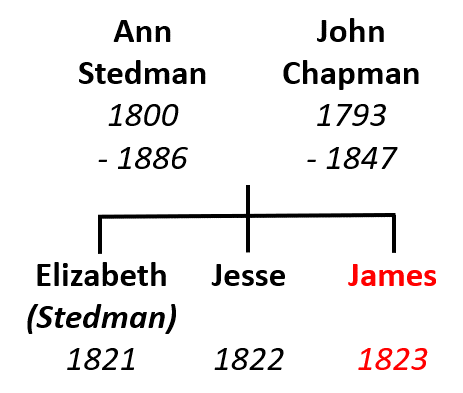 Before her marriage to James’s father John Chapman, his mother Ann had an illegitimate daughter Elizabeth Stedman who was baptised on 17th February 1821 at St Peter’s, exactly two weeks after Ann and John were married there 2, 3. The baptism record said: ‘Elizabeth illegitimate daughter of John (crossed through) Ann Stedman of Mayford’ so it seems certain that John was the father of Elizabeth, making her a full sister for James.
James also had an elder brother Jesse born in about 1822 4.
By the time of the 1841 Census, all the family were living in Hook Hill (Hook Heath), just south of Woking 5. Much of the area around Woking at that time was given over to plant nurseries, with James’s father John, a ‘nurseryman’, running the Royal Oak Nursery, near to Woking Station, which consisted of 4 acres of land 6. James and his brother Jesse were both ‘nursery labourers’, most likely working for their father.
While James never married, both of his siblings did – Jesse to Amelia Smith in July 1846 and Elizabeth to John Daborn the following March 7, 8. However, the Chapman family were struck a severe blow less than six months later when James’s father John died in October 1847, aged 54, from ‘delirium tremens’, indicating he had been heavily addicted to alcohol 9.
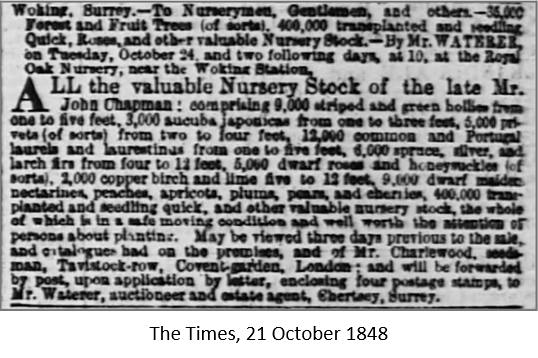 It would seem that neither 24-year-old James nor his elder brother Jesse were willing or able to take over the nursery, as the following year, a notice in The Times newspaper advertised an auction of John’s nursery stock which included ‘35,000 Forest and Fruit Trees (of sorts), 400,000 transplanted and seedling. Quick, Roses, and other valuable Nursery stock’ 10.
What happened at the auction is not known, but the 1851 Census listed James and Jesse as ‘farmer’s sons’, living with their mother Ann in Hook Heath, a farmer with ‘2 acres, 2 labs (labourers)‘ – who were presumably James and Jesse 11. The wife and son of Jesse were also there. James’ elder sister Elizabeth, her husband and their three children, were living in the neighbouring Goldsworth area of Woking, next to the Royal Oak nursery 12.
James has not been definitively traced in the 1861 Census, as his is a common name in the area. He was not with his mother Ann, who was now a housekeeper for a widow in The Lye, Goldsworth, or with his brother Jesse and family in Hook Heath 13, 14. Elizabeth and her family had moved to Battersea, south London 15.
The next record found for James was in the Guildford Union Poor Law Accounts for 1869, which showed that James, now in his mid-forties, had been given a medical order worth 6s 3d (£0.31 approx) for ‘sickness’ whilst living in Hook Hill, almost certainly with his mother Ann, who had been receiving poor relief since 1867 for ‘bad legs’ 16, 17.
The 1871 Census confirmed that James and his 70-year-old mother Ann, a ‘retired laundress’, were under the same roof in St John’s, Woking 18. James was an ‘ag lab’ (agricultural labourer), although no indication was given as to where he was working.
There are no further Poor Law Account records available after 1871, but it would seem certain that James’s mother would not have been very mobile and not been able to help James if he had problems himself.
By 1881, James had become an inmate of the Guildford Union Workhouse, noted as an unmarried ‘general labourer’ 19. Despite his mother Ann’s age and ‘bad legs’, the 1881 Census showed her not in the Workhouse with James, but boarding with nursery labourer Frederick Spooner and his family in Hook Heath 20. Ann now had some funding, as she was described as an ‘annuitant’. Where this money had come from is unclear – her husband had died over 30 years ago. As previously mentioned, she had been receiving Poor Law benefits for ill-health, something that would not have happened if she had had the means to pay for treatment. Ann’s other son, Jesse, was doing well – he and his wife were now running a 14-acre farm and living almost next door to Ann in Hook Heath, so perhaps she was being funded by him 21.
There are no available records to indicate exactly when James had entered the Workhouse, or whether he remained there throughout the 1880s. The 1891 Census listed him as a 68-year-old pauper inmate 22. His mother Ann had passed away in Hook Heath five years earlier aged 88, while his brother Jesse had died in January 1891 aged about 69 23, 24.
J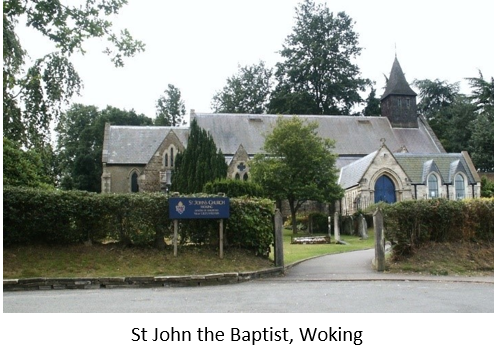 ames almost certainly remained in the Guildford Union Workhouse until his death there on 3rd June 1896 from ‘congestion of lungs’ and ‘senile decay’, aged about 73 25. His burial took place three days later at the family church of St John’s, Woking, like his parents and his brother Jesse before him 26.
James’ sister Elizabeth Daborn remained with her family in the Battersea area of south London until her death in August 1903, aged 82 27, 28.
March 2021, updated October 2026
Edited by Mike Brock
We’d love to hear from you if you are a relative of this Chapman family, or simply enjoyed the biography.
 Contact us by email at spikelives@charlotteville.co.uk
Facebook at ‘Tales from Guildford Workhouse’ Instagram at Guildford SpikeLives
More biographies involving nurserymen in Woking
- George Jackman Family care for grandson of the founder of Jackman’s nursery
- George Nottridge Woking man employed at renowned Goldsworth Nursery
- Sarah (née Hall), Mary Ann, William and Amelia Jane Spooner Seven children, four fathers but Knaphill family bond stays strong
Sources and References
Surrey parish and Guildford Union records are available at the Surrey History Centre, Woking. Digitised records were sourced through Ancestry.co.uk. A complete list of references may be found at James Chapman references
 Spike Lives is a Heritage project that chronicles the lives of inmates, staff and the Board of Guardians of the Guildford Union Workhouse at the time of the 1881 Census. The Spike Heritage Museum in Guildford offers guided tours which present a unique opportunity to discover what life was like in the Casual/Vagrant ward of a Workhouse. More information can be found here