
Subject: Mary Ann Ames (b 1811 – d 1891)
Researcher: Christine Clarke
GUILDFORD UNION WORKHOUSE SCHOOL MISTRESS 1838 – 1885
NEARLY HALF A CENTURY OF WORKHOUSE TEACHING
Mary Ann Ames, her parents James and Elizabeth, and younger brother James, played a crucial role in the early years of the Guildford Union Workhouse. For possibly all of her working life, Mary Ann helped give countless numbers of disadvantaged children a helping hand for their lives outside the Workhouse, long before education became compulsory across the nation, making her a true unsung hero of the Victorian era.
Childhood and early years
Mary Ann, the eldest of six known children for shoemaker Thomas Ames and his wife Elizabeth née Roake, was born on 9th April 1811 in Turnham Green, Middlesex, and baptised at St Nicholas, Chiswick, 19 days later 1, 2.
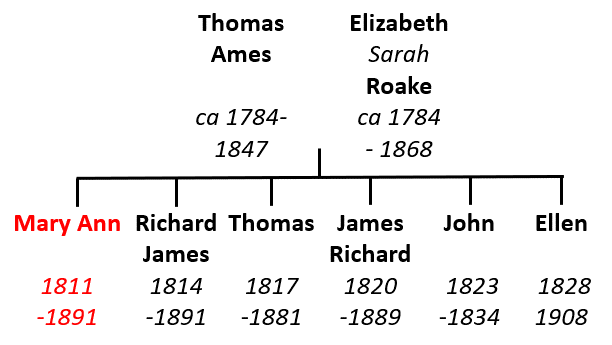 By 1815, the family had moved to Chertsey, Surrey, where Mary Ann’s mother was from 3.
Mary Ann’s brothers Richard and Thomas were baptised in nearby Shepperton, while the rest of her siblings – James, John and Ellen – were baptised at Chertsey’s St Peter’s Church 4, 5.
In 1826, the family was living in Addlestone, just to the south-east of Chertsey. This was recorded on the will of Mary Ann’s grandfather, farmer Richard Roake, who, upon his death left her mother ‘Elizabeth Ames the wife of Thomas Ames of Addlestone aforesaid shoemaker the sum of fifty pounds to her for her own sole and separate use…’ – a sizeable sum 6, 7.
Mary Ann was about 15 at this time. It seems certain that, with her mother’s background and her father’s work as a shoemaker, there would have been sufficient funds to pay for her, and her siblings’, education. A further indication of the family’s financial stability was that Thomas owned the cottage where they lived on Addlestone Moor 8.
It’s worth noting that Richard Roake’s will did not state that Elizabeth was his daughter, instead naming seven other now adult children as his offspring. This was because Elizabeth was the daughter of his first wife Sarah who had died shortly after Elizabeth was born. Richard then married Sarah’s sister, making Elizabeth a half-sister to the other seven.
Mary Ann’s parents become Master and Matron of Godalming Workhouse ….
The family suffered the loss of Mary Ann’s youngest brother John in November 1834 who died aged 12, from causes unknown – the introduction of death certificates was not until three years later 9. Around this time, Mary Ann and the family moved about a mile (1.6km) from Addlestone Moor to the Chertsey Workhouse, where her father Thomas was now employed 10. He retained their cottage, renting it out, with his main abode being the Chertsey Workhouse ‘at the bottom of Guildford Street, Chertsey’ 11. Thomas continued to rent out his cottage for the rest of his life 12, 13.
Whether Thomas was employed only as a shoemaker at the Chertsey Workhouse is not known, although shoemakers were often used by workhouses to train boy inmates.
Whatever his role in Chertsey had been, Thomas and his wife Elizabeth were appointed Master and Matron of Godalming’s Workhouse on 24th December 1836 which would certainly have been a step-up for the Ames 14.
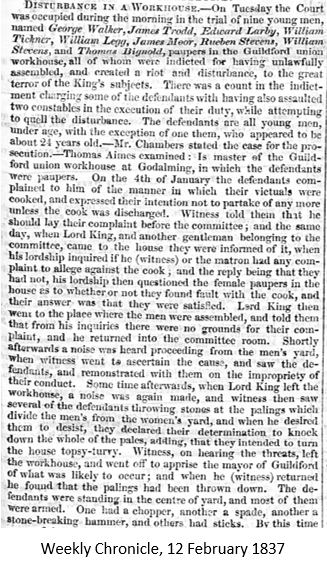 At the same time, the Board of Guardians were also seeking a married couple as schoolmaster and schoolmistress for Godalming Workhouse. It appears this was a more difficult role to fill, and no record has been found of any appointment 15. It would seem likely that 25-year-old Mary Ann helped in the Workhouse with teaching, although no proof of this has been found.
Thomas and Elizabeth were not taking on an easy role. The Godalming Workhouse was an old building, difficult and expensive to maintain, and well-known as an unruly place 16. For example, just over a week after the Ames were brought in, a riot took place in the Workhouse over the poor quality of the inmates’ food 17.
…. and then Master and Matron of the new Guildford Union Workhouse
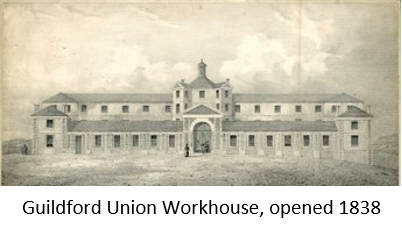 The Guildford Union was obliged to retain the Godalming Workhouse until 1838, when the newly built Guildford Union Workhouse was finally opened, allowing the paupers from Godalming and elsewhere in the Union all to be accommodated in one large building, more efficiently and with less cost.
Mary Ann’s parents must have impressed the authorities with their work at Godalming because in August 1838, Thomas was first choice to be the Master of the Guildford Union Workhouse, with his wife, Elizabeth, as Matron 18. Their respective salaries were £60 and £40 per annum with board and lodging.
Miss Ames – Schoolmistress
Mary Ann was appointed soon after as schoolmistress at a salary of £25 per annum plus board and lodging, so it would seem likely that she had indeed gained teaching experience at the Godalming Workhouse 19. The new schoolmaster was John Woodyer, who earned significantly more than Mary Ann, at £35 per annum.
In the first five years of her tenure, there were five different schoolmasters, whose employment was curtailed due to resignation, incompetence, or scandal 20.
By the time of the 1841 Census, the Ames family was well-established at the new Union Workhouse, with Thomas, Elizabeth and Mary Ann, now 30, employed and living there along with Mary Ann’s youngest sibling, 13-year-old Ellen 21. Mary Ann’s eldest brother Richard had remained in Chertsey, where he and his recently married wife Sarah were working as servants 22. Thomas was a servant in Bentley, near Farnham, while her youngest brother, James, was in Godalming working as a shopman, living at the home of a tea dealer and his wife 23, 24.
The Workhouse School
Children in the larger workhouses like Guildford were generally taught in large single sex classes. At the time of the 1841 Census, Mary Ann was teaching some 37 girls and the schoolmaster Mr Thayre about 33 boys, with the children, aged between 4 and 13, accounting for almost one third of the Workhouse inmates 25. Class sizes fluctuated according to the comings and goings of the inmates, with some children staying a few days whilst others would have spent their whole childhood there.
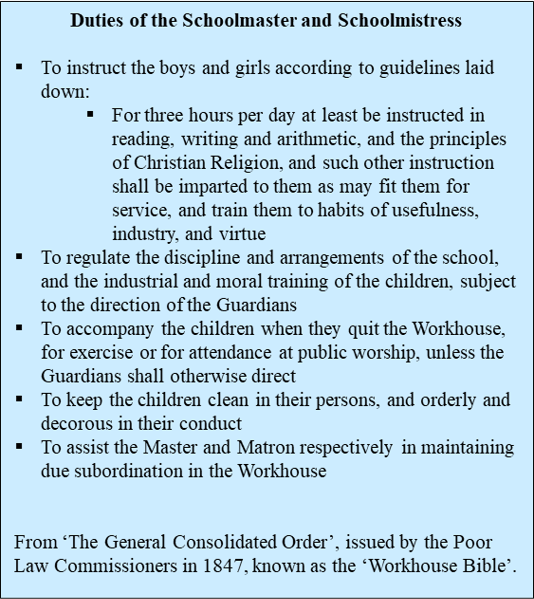 The 1834 Poor Law Act had stipulated that workhouse children should have at least three hours of schooling per day 26. In the morning session, emphasis was laid on the three Rs and religious instruction. The Chaplain had overall responsibility for teaching the pupils about religion and moral duties. More practical instruction was given after the dinner break, to equip them for employment when they left the Workhouse around the age of 12 or 13. Girls would learn domestic work, washing clothes, cookery, knitting, and sewing. Boys were taught trades such as shoemaking, tailoring and carpentry as well as working in the Workhouse vegetable garden 27, 28.
Much learning would be by rote and class control was of great importance. After 1847, corporal punishment was permitted for boys only, with children expected to be respectful and polite to t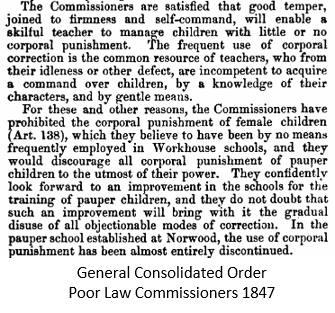 heir elders.
Levels of attainment might not have seemed high by modern standards, but workhouse children were receiving a basic education and even some industrial training when, by comparison, other children from poor families often received none. Education for children in the UK did not become available for all children until 1870.
 Initial inspections of the standard of education within the Guildford Union Workhouse were carried out by the House Visiting Committee, consisting of members of the Board of Guardians.
One such inspection in April 1839, 8 months after Mary Ann’s appointment, saw one Guardian raise concerns over the standard of teaching ‘with a view of appointing a more efficient Schoolmaster and Mistress or having the present Schoolmaster and Mistress instructed in an improved System of Education’ 29. His views were not echoed, however, by other members of the Visiting Committee who were satisfied with the status quo and dismissed his proposal. Their report from May 1839 even stated that ‘the attainment of both the boys and the girls in Reading, Writing and Ciphering (arithmetic) equals their expectation and far surpasses the Education which the majority of independent Labourers can obtain for their Children’.
Mary Ann’s brother appointed somewhat controversially as Schoolmaster ….
After the resignation of then schoolmaster Richard Harwood in February 1843, the only applicant was Mary Ann’s 22-year-old brother, James, who was appointed to the post the following month 30. This was not without some disapproval from the Poor Law Commissioners, overseers of all Workhouses, who noted that James had no relevant experience or training and that ‘the Salary should enable them (Guildford Union) to obtain the services of a well-qualified candidate’. These objections were rejected by the Guildford Board of Guardians. This meant there were now four members of the Ames family on the Workhouse staff. Mary Ann’s younger sister Ellen had moved on, becoming a live-in shop assistant for a bookseller in Guildford High Street 31.
In June 1845 a complaint of excessive cruelty and lax supervision was made against schoolmaster James after it was found that ‘occasionally he has struck the boys with a small stick or with the hand but not in a severe manner’ and that he had left his pupils under the supervision of one of the boys or an adult pauper while he had gone out. Although charges of cruelty were rejected, James was admonished for twice being absent from his duties without the permission of the Board 32.
…. And then Master
In 1847, Mary Ann’s father Thomas, Master of the Workhouse, died. He was buried in October at St Peter’s, Chertsey, where his son John had been buried 13 years earlier 33.
Apart from losing her husband, this could have had further catastrophic consequences for Mary Ann’s mother Elizabeth. Generally, the posts of Master and Matron were given to a married couple, so Elizabeth would have been expecting to lose her employment and with it her home. Perhaps surprisingly, considering his age and previous tarnished record, the Board of Guardians of Guildford Union promoted Mary Ann’s brother James, just 27, to his father’s former post, with their mother Elizabeth allowed to continue as Matron 34.
In 1847, the same year as Thomas’s death, the Poor Law Schools Inspectorate was set up, independent from the Poor Law Commission, to improve the standard and control of workhouse education 35. One of the Guildford Union’s early inspections was made by Edward Carleton Tufnell to see Mary Ann and her brother James’ replacement, Samuel Lovell, at work. The Inspector was pleased with what he found – ‘the quality of the instruction in the boys’ school has been much improved’, while for Mary Ann, ‘the girls were fairly instructed in all the ordinary 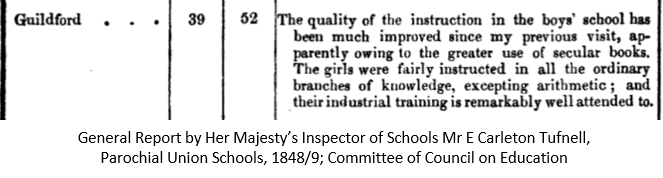 branches of knowledge, excepting arithmetic; their industrial training is remarkably well attended to’ 36.
That little exception about arithmetic, perhaps, was the reason in April 1852 that the Board of Guardians ‘ordered that the Clerk write to the Schoolmistress and inform her that the Board expect that she will be examined by Mr Tufnell as she has hitherto declined such examination’ 37. Mary Ann took and passed the examination to continue in her post. She continued to receive yearly certificates for ‘Competency’, with her rates of pay dependent on these. Although we have no proof of Mary Ann’s character, the evidence would suggest that she was certainly determined, and perhaps somewhat combative.
A Workhouse School is built
I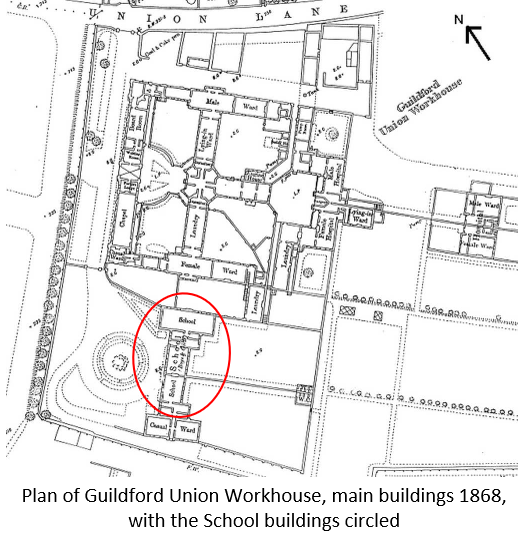 n 1857, the Guildford Union opened a bespoke school, detached from the main Workhouse buildings as separation from the adult paupers was considered beneficial for the children. A classroom each for boys and girls, two dining halls, dormitories, lavatories and yards were provided 38. The boys’ side had two workrooms for industrial training, and the girls’ side a laundry. Mary Ann and the schoolmaster were also each provided with a sitting room and bedroom.
However, Mr. Tufnell noted during his next inspection that although the school buildings had improved education, a separate drying and laundry yard for the instruction of the girls should be constructed, in line with those found in other Workhouse Schools 39, 40. An Industrial Assistant would also be needed to teach laundry and needlework. This was rejected by the Board who stated: ’This is considered unnecessary as there are so few Girls to be instructed and that they all obtain situations as soon as they are of sufficient age for service’. The purpose of the Workhouse education was to train children to be able to earn some kind of living and not be reliant on the Parish in later life, so it appears that Guildford was successful in this respect.
1863 sees upheaval, with a new Workhouse Master and Matron
I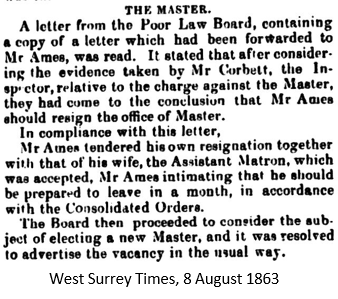 n the Spring and Summer of 1863, Mary Ann’s brother James, now married and with children, came under suspicion and was eventually suspended from his post as Master of the Workhouse 41, 42. The Medical Officer stated that James ‘was incompetent to the discharge of his duties by reason of his labouring under a severe attack of delirium tremens accompanied by other symptoms’. The Guardians later noted that James was addicted to drinking and was in the habit of frequenting public houses – indeed, his wife was the daughter of a licensed victualler. Numerous inaccuracies had been noted in his accounts and record keeping. James strenuously denied these charges but eventually resigned on 1st August.
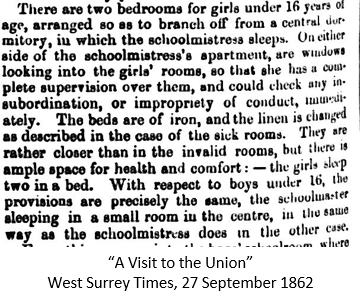 There was trouble for Mary Ann too, as the Workhouse Visiting Committee reported to the Board that Mary Ann ‘did not occupy and sleep in rooms provided for her next to those of the children’ 43. She was told by the Board to do so in the future, but whether her absence had just been a temporary issue or had been going on since the provision of these rooms back in 1857, is not known.
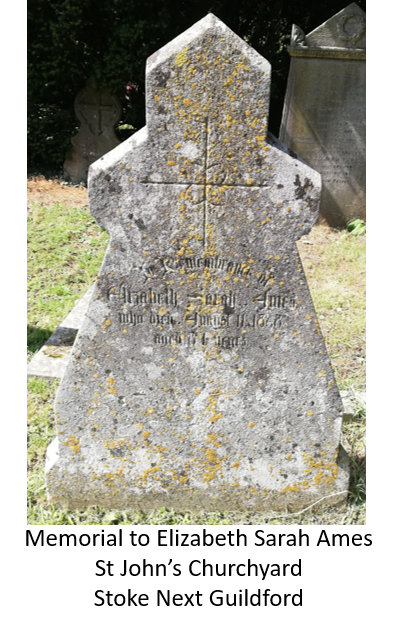 Mary Ann was able to continue as schoolmistress, but her mother Elizabeth was forced to resign as Matron following James’s departure, being replaced in October 1863 by the wife of Richard Davis, the new Master of the Workhouse. Elizabeth was awarded a pension of two-thirds of her salary and allowed to live in those rooms provided for Mary Ann. This situation continued until Elizabeth’s death, aged 84, in August 1868 44. Under her full name Elizabeth Sarah Ames, she was buried in the churchyard of St John the Evangelist, Stoke-Next-Guildford.
In 1869, another Workhouse inspection took place, with Mr Tufnell writing in the Visitor’s Book, ‘Both the Boys & Girls Schools are in good order and passed a satisfactory examination – I was especially pleased with the boys in all respects more particularly with their singing and band music’ 45. Clearly, Mr Tufnell was now more supportive of Mary Ann’s teaching qualities than he had been on some previous visits.
The Elementary Education Act of 1870 made the provision of elementary education for all children aged 5 to 13, establishing locally elected school boards to build and run schools in areas which lacked them 46. This did not initially affect Mary Ann’s teaching in the Workhouse, but a change did occur when the current schoolmaster left his position at the end of 1873 and the Local Government Board gave permission to appoint an extra schoolmistress rather than a schoolmaster 47.
In January 1874, Miss Ann Matthews Rooke, a well-qualified schoolmistress with experience at the Kington Union Workhouse, Herefordshire, was chosen to fill the vacancy at a salary of £25 plus rations.
Unfortunately, this experiment failed because she tendered her resignation just a year later 48. After consideration by the Board, in March 1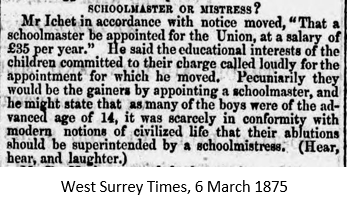 875, Guardian Mr Ichet moved ‘That a Schoolmaster be appointed for the Union, at a salary of £35 per year’. Women teachers might be less expensive, but controlling large numbers of unruly boys was obviously seen as a man’s job 49.
Older pupils to Stoke School
The system of education in the Guildford Union Workhouse began to change after the resignation of yet another schoolmaster in early 1877 50. Instead of being t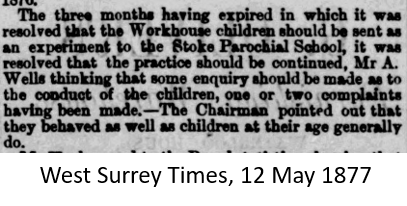 aught in the Workhouse, the older inmate boys were sent to the nearby Stoke Church of England School. The Workhouse Master had to compile a daily list of the pupils going to the school which included the time they left and returned to the Workhouse. In return, the school was expected to inform him of any truancy or misbehaviour. Stoke School received 5 shillings (£0.25) per head from the Union with the children being escorted to and from the school by the workhouse porter. In the Stoke School logbook, it was noted on the week beginning 5th February 1877 that 13 boys from the Union were admitted, as the Guardians had determined, ‘to discontinue the maintenance of a separate school for their boys and girls’ 51.
The education of younger Workhouse children continued under Mary Ann. In 1882, Mr Wyndham Holgate, Inspector of Workhouse Schools, after being shown around the Workhouse classroom and Stoke School, reported that he ‘Visited the House to report on the Infant School which is going on much the same under Miss Ames’ care. I am glad to find a Report entered as to the progress of the older children at the Stoke School’ 52.
With the older pupils being educated outside the Workhouse, Mary Ann’s workload was reduced, so she was able to help in other areas. In December 1883, she had a small acknowledgement in the local paper for her part in the Christmas festivities at the Workhouse. ‘On the 21st inst… a 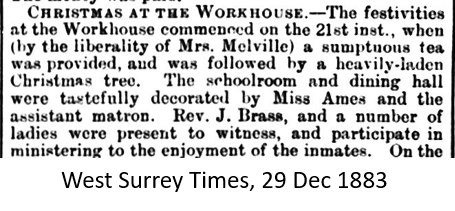 sumptuous tea was provided and was followed by a heavily-laden Christmas tree. The schoolroom and dining hall were tastefully decorated by Miss Ames and the assistant matron’ 53.
Mary Ann retires and Guildford Workhouse schooling ends
In August 1885, aged 74 and after 47 years in her position, Mary Ann handed in her resignation, ‘by reason of permanent infirmity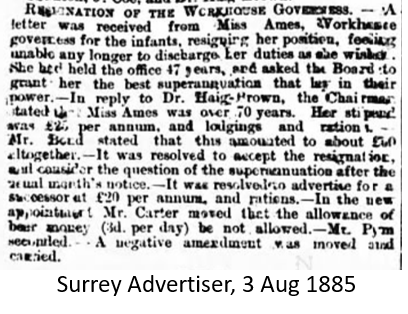 of body’ 54. Despite never having been a fully qualified teacher, she had always been assessed as ‘Probation First’, recognising her level of competence.
For her retirement, the Local Government Board gave Mary Ann an annual allowance of £40. Her pay had always been less than that of the schoolmaster and had been reduced in her later years, possibly because she was now only teaching infant Workhouse children.
 The Guardians took the opportunity to reduce the salary even further when advertising for her replacement, although the new schoolmistress would be responsible not only for teaching infants during school hours, but also for superintending the industrial training of the girls, managing them, and, if possible, ‘play the harmonium’ 55, 56.
Mary Ann’s replacement only lasted a month or so before resigning. Whatever the reason for her departure, the following year 1886 saw education in the Workhouse further reduced when younger girls and infants from the Workhouse were sent for tuition at local schools 57.
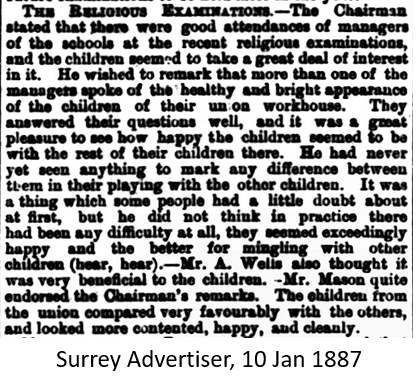 A report in the Surrey Advertiser in January 1887 indicated, not surprisingly, that Workhouse children were happy to be attending local schools and ‘the better for mingling with other children’ 58. The Chairman of the School Board, Mr Aaron Wells, also a Guardian of the Guildford Union, concluded that ‘it was very beneficial to the children’, signalling the imminent end to education in the Workhouse.
Later years in Somerset
Mary Ann, meanwhile, had moved to Freshford in Somerset, southeast of Bath, to live with her older brother Richard and his second wife 59. The 1891 Census described her as living ‘on her own means’ 60. That Census also confirmed that the Guildford Union Workhouse were no longer employing teachers, so Mary Ann had been in that role for almost the entire time education had taken place there 61.
Mary Ann finally succumbed to the poor health of her later years, passing away aged 80 on 20th August 1891 and was buried in Freshford Cemetery 62, 63.
Mary Ann’s siblings
Just two months after Mary Ann’s death, her brother RICHARD passed away aged 77 and was interred alongside Mary Ann in the family plot in Freshford 64. He had been a rent collector, and since leaving Surrey in the 1850s, had also worked as a pawnbroker and house lettings agent 65.
JAMES, who had been Master of the Guildford Workhouse from 1847 until being forced to resign because of a drink problem in 18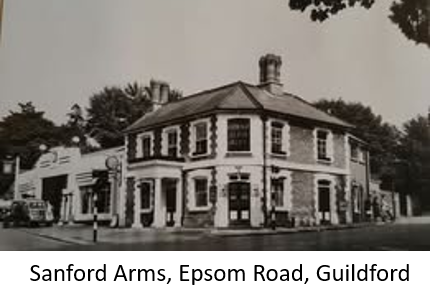 63, managed to persuade the authorities two years later that he was no longer addicted to drink, allowing him to become landlord of the Sanford Arms Inn, latterly the Rogues‘ Bar, on Epsom Road, Guildford 66. This did not last long as by June 1870, the landlord was Harry Honey, with the 1871 Census, somewhat strangely perhaps, noting James as a ‘plumber’s labourer’ living in Addison Road, Guildford 67, 68. Ten years later, James was the ‘Bailiff of County Court’, still at the same address 69. He passed away in July 1889, aged 68 and was buried in the churchyard of St John the Evangelist, Stoke-Next-Guildford, like his mother had been 70. James had been the only one of the six siblings to raise a family.
THOMAS Ames, who had moved to Bentley, just over the Hampshire border, sometime before t he 1841 Census, married Ann Windebank there in June 1844, witnessed and signed by Mary Ann and brother James 71, 72.
T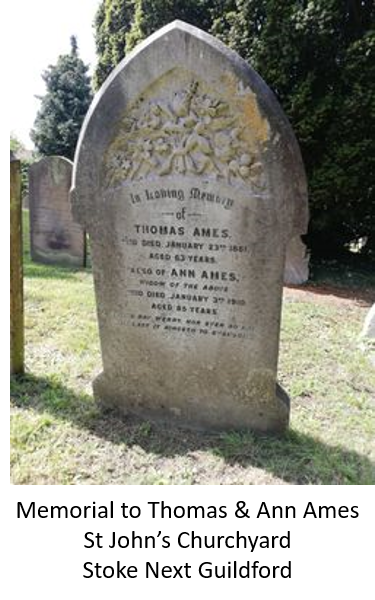 homas, a ‘groom’ at the time of his marriage, was a grocer’s porter in Guildford by 1851, progressing to be a grocer’s warehouseman by 1861 73. He became a beer house keeper after that in Drummond Road, Guildford, passing away there in January 1881, aged 63 74. His wife Ann took over the business before retiring sometime after 1891 75, 76. Ann died aged 85 in January 1910 77. Thomas and Ann’s memorial is at St John the Evangelist, Stoke-Next-Guildford, close to the graves of Thomas‘s mother Elizabeth and his brother James.
Mary Ann’s sister ELLEN never married. After working in Guildford for a bookseller and then a chemist, she became a nurse and then matron at a small school for boys in Hove, Sussex 78. After retirement, she remained in Hove where she died in 1908, aged, 79 79, 80.
April 2025, updated October 2026
Edited by Mike Brock
We’d love to hear from you if you are a relative of the Ames family, and would especially love a photograph of Mary Ann.
 Contact us by email at spikelives@charlotteville.co.uk
Facebook at Tales from Guildford Workhouse Instagram at GuildfordSpikeLives
Sources and References
The primary sources of information were the Guildford Union Board of Guardians Minute Books, held at the Surrey History Centre, Woking, references BG6/11/1-22. Original Surrey newspapers and parish records are also held there. Board of Guardians meetings were reported extensively in the newspapers of the day. Ancestry.co.uk was used for digitised parish, census and other records. A complete list of sources may be found at Mary Ann Ames References
 Spike Lives is a Heritage project that chronicles the lives of inmates, staff and the Board of Guardians of the Guildford Union Workhouse at the time of the 1881 Census. The Spike Heritage Museum in Guildford offers guided tours which present a unique opportunity to discover what life was like in the Casual/Vagrant ward of a Workhouse. More information can be found here