
Subject : Jane Fleet (unknown ca 1800? – d 1884)
Researchers : Pauline Sieler & Mike Brock
Ionian Islands to Guildford Union Workhouse for widow of Woking-born Battle of Waterloo veteran
Sussex-born Jane Hide, who married Battle of Waterloo veteran James Fleet in 1820, spent 13 years with him and their family in the Ionian Islands and eight further years in Brighton before James passed away in 1844. Despite Jane remaining in Brighton for almost the next 30 years until she became an inmate of the local Workhouse, Poor Law rules meant that she was moved to the Guildford Union Workhouse because her husband had been born in Woking, making the Guildford Union responsible for Jane’s care in her final years.
Jane was born in Goring-by-Sea, near Worthing, West Sussex. Later Census and workhouse records indicate this could have been as early as 1789, but the only baptism record that has been traced for someone of that name was the Jane Hide baptised in Goring on 25th January 1801, the illegitimate daughter of Ann Hide 1.
The first confirmed record found for Jane is her marriage to James Fleet in Winchester, Hampshire on 22nd December 1820 2. Although the certificate says nothing about Jane and James other than them both being ‘of this parish’ of Winchester, the earlier dramatic life of James and his involvement in one of the most famous moments in British history gives some clue as to how they came to be together.
The Battle of Waterloo
James was born in Woking, Surrey, the son of Elijah and Ann Fleet, and baptised on Christmas Day 1791 at the town’s St Peter’s Church 3. About the age of 22, James enlisted for the 51st Regiment of Foot in Chelmsford, Essex in December 1813 4. The 51st Regiment had been involved in fighting the Napoleonic Wars since 1811 but returned to Britain after Napoleon had been defeated and exiled to Elba in 1814 5 . In March 1815, news came that Napoleon had escaped exile and was gathering an army in France, so the British Army began sending troops back across the English Channel, including James’s 51st Regiment, who left Portsmouth for Ostend that month 6.
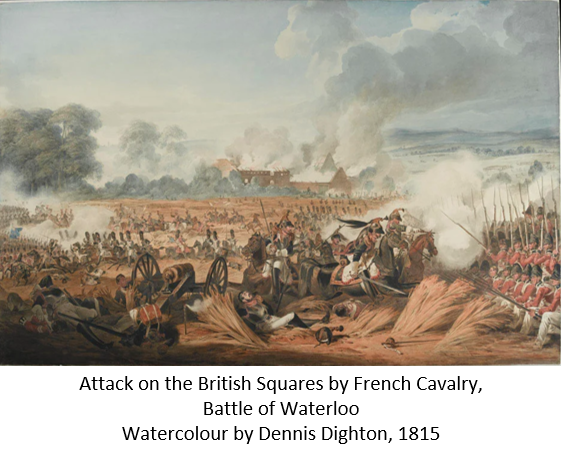 On 18th June 1815, James and his Regiment had assembled at Hougoumont, about 12 miles (20km) south of Brussels. Under the command of the Duke of Wellington, around 68,000 soldiers, of which James’s 51st Regiment numbered 795, alongside 50,000 Prussian Army troops led by Field Marshal Bucher, faced up to Napoleon’s 73,000-strong French Army at what was to become known as the Battle of Waterloo.
 James’s Regiment has been credited with firing the first shots on the battlefield, although they remained on the periphery of the most serious fighting, suffering only a handful of losses. However, the Regiment did recapture several escaping French heavy cavalry ‘cuirassiers’ as Napoleon’s Army was defeated. James, like all the other British soldiers involved in the battle, was awarded the Waterloo Medal by the Prince Regent, later George IV 7.
The 51st Regiment returned to England in January 1816 and over the course of the next five years, were based in southern England, including Brighton and Winchester, during which time Jane would almost certainly have met James, leading to their marriage in 1820.
 Posting to the United States of the Ionian Islands
Having been on domestic duties since the Battle of Waterloo, James and the 51st Regiment were posted in 1821 to the ‘United States of the Ionian Islands’, a protectorate of the British Empire established by the Treaty of Paris signed after France’s defeat at Waterloo 8. The seven islands included Corfu, Kefalonia, Lefkada and Zakynthos situated off Greece’s west coast but were not yet part of the country. Greece had just begun its own fight for independence from the Ottoman Empire, making the Ionian Islands a significant place for Britain, one of Greece’s allies.
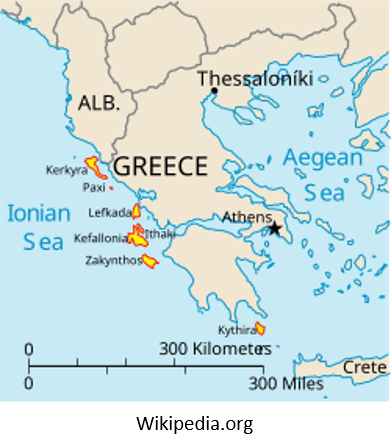 Jane was allowed to travel with husband James, quite a privilege for a humble private soldier, arriving in June 1821 in Corfu 9. During the next 13 years, the 51st Regiment moved around the Ionian Islands, and in 1824 were in Lefkada, where Jane and James’ daughter Mary was born that August 10. However, they soon moved on to Cephalonia (Kefalonia) where Mary was baptised three months later. A second daughter, Anne, was born on Cephalonia in September 1825 11.
During the family’s time in the Ionian Islands, Greece gained full independence from the Ottoman Empire in 1830 12. 34 years later, the British Government ceded the Ionian Islands to Greece, ending nearly 50 years of British rule.
Back in June 1834, the 51st Regiment returned home from the Ionian Islands, with James’s time in the Army coming to an end in November 1836 when, aged 44, ‘chronic hepatitis’ saw him declared unfit for further service after almost 23 years with his Regiment 13, 14. Thanks to having served at the Battle of Waterloo, James was credited with two extra years of service which increased his pension to 1s 2d (£0.06 approx) per day, although this was still a little short of a labourer’s average weekly wage of around 10 shillings (£0.50) 15. James, described on discharge as 5’ 9” (1.75m) tall, with brown hair, grey eyes and a fresh complexion, had remained a private throughout his Army career but had been a ‘good and efficient soldier… trustworthy and sober’.
Brighton
Jane, James and their family settled at 16 Crown Gardens, Brighton, which was described in bold type in a newspaper advertisement of 1837 as a ‘DESIRABLE PROPERTY’ 16. The couple’s son James was born that year, but he died aged 8 months from ‘decline’ in June 1838 17. Jane and James’s last child William was born in February 1840, with James noted as a ‘gardener’ on the baptism record two months later 18, 19.
The 1841 Census showed Jane, James and three children still living in Crown Gardens 20. Daughters Maria, 20, and 15-year-old Ann were both working as domestic servants while James was an ‘agricultural labourer’ so there was a reasonable income for the family to live on. Jane was not in employment, but would’ve been at home, caring for young William. Whether Lefkada-born ‘Mary’ was Jane and James’s daughter ‘Maria’ named on this Census and later records is unclear, but no other birth record has been traced for a ‘Maria’.
James’s health would clearly have been a concern because of his hepatitis, but it was a bout of pneumonia that ended his life in April 1844, aged 52 21. Despite James’s long, unblemished Army career, Jane would not have received any financial assistance as only officers’ widows were entitled to receive their husband’s pension 22.
Dire straits
Jane and her family’s loss of James was therefore a severe blow to their ability to remain in their family home. Even if Jane did find employment, she would have almost certainly earned less than James’ pension and wage, plus she had the responsibility of caring for her son William, just 4 years old.
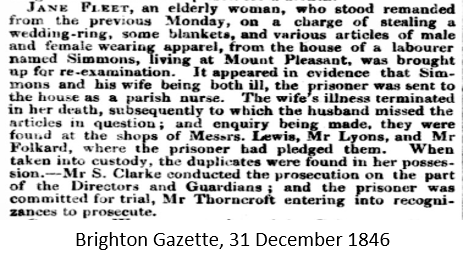 Jane’s desperation became clear in January 1847 when she was sent to prison for three months for larceny 23, 24. Jane had found work as a ‘parish nurse’, a medically unskilled position to attend to people in their own home that were suffering from illness. Jane, while visiting a married couple, stole a wedding ring, some blankets and clothing which she took to three separate pawnbrokers’ shops before the husband noticed the items were missing. The receipts for the items were found in Jane’s possession, so she was jailed.
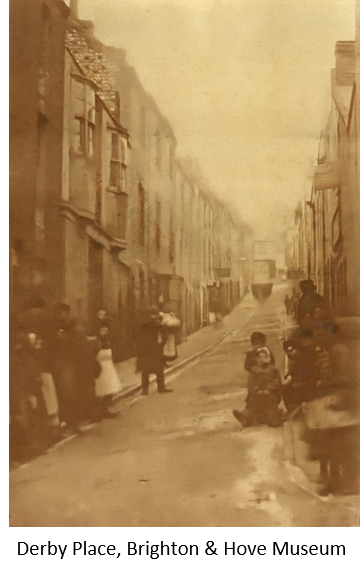 The family’s plight became worse still in May 1848 when Jane’s daughter Maria died from ‘epilepsy’, aged 28 25. She had been living in Egremont Street, described by an observer of the time as a street of ‘misery and vice’ 26. Jane’s other daughter Ann, a dressmaker, was also a resident of that street by 1851 lodging with the Hitchings’ family 27. Jane was no better off, residing in 1851 in Derby Place, Brighton, noted in a newspaper article as ‘one of the worst localities in the town’ 28, 29. Jane was working as a charwoman, living with her 11-year-old son William.
By 1861 Jane was living alone at 16 Egremont Street, still employed as a charwoman 30. Four years earlier, an inquest held following the death of a resident next door to number 16 gave a graphic description of the conditions of the neighbour’s house, saying: ‘… we should have scarcely thought it possible for so much wretchedness and squalor to be in existence in Brighton. … The house externally presented extreme marks of dilapidation … We were told that the floorings and stairs were frequently torn up by the poor creatures living in the street for the sake of firing’ 31. Although this was of course not Jane’s home, it is clear she was living in a desperately poor slum area – the entire street was pulled down 40 years later 32.
Jane did still have her two children close at hand, though. Her son William was lodging with his sister Ann and her husband just around the corner in Hereford Street 33. Back in December 1855, Ann had married William Hitchings with whom she been lodging in Egremont Street 34. Later in 1861, son William married Sarah Jane Hudson who gave her address as his mother Jane’s home, 16 Egremont Street 35.
In July 1865, Jane was probably living with, or close next door to, her daughter Ann and family, as a newspaper gave Jane’s address as Hereford Street when it reported on her giving evidence concerning the theft of a pillow 36. However, at the time of the 1871 Census, Jane has not been traced. Ann and her family had moved to Lambeth, South London while Jane’s son William and family were still in Brighton 37, 38.
Although Jane was not recorded in the new Brighton Union Workhouse in Elm Grove at this time, she was an inmate soon after 39. In February 1873, the Brighton Union Guardians wrote to the Guildford Union requesting them to accept their inmate Jane Fleet because she belonged to the Woking parish 40. Although Jane had probably never lived in Surrey, her late husband James was born in Woking, so the Guildford Union was obliged to accept her.
What Jane thought of this decision can only be guessed at, but she was to remain in the Guildford Union Workhouse for probably 13 years until she passed away there on 31st March 1884 from ‘decay of age’, the ‘Widow of James Fleet a Soldier of Woking’, with her age given as 91 41, 42. Jane was buried at Woking’s St John’s Church, somewhat ironically perhaps, as it was not the Church of her husband James’s family, which was St Peter’s on the other side of town 43.
December 2019, updated December 2025
Edited by Mike Brock
We’d love to hear from you if you are a relative of James and Jane Fleet. Please contact us by email at spikelives@charlotteville.co.uk
Sources and References
Original Surrey parish records and Board of Guardian Minute Books are available at the Surrey History Centre, Woking. Digitised parish records were sourced through Ancestry.co.uk. Newspaper articles were sourced through British Newspaper Archive/FindMyPast.co.uk. A complete list is at Jane Fleet references
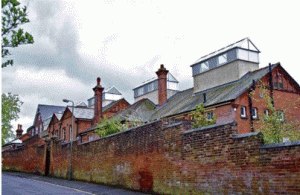 Spike Lives is a Heritage project that chronicles the lives of inmates, staff and the Board of Guardians of the Guildford Union Workhouse at the time of the 1881 Census. The Spike Heritage Museum in Guildford offers guided tours which present a unique opportunity to discover what life was like in the Casual/Vagrant ward of a Workhouse. More information can be found here