
Subjects : Harriet Rogers Tickner née Mercer (b 1847 – d 1895)
Benjamin otherwise David Leslie Birch Rogers (b 1880 – d 1881)
Researchers : Sue Driscoll, Mike Brock, Carol Thompson
Former Guildford Union Workhouse inmate murdered in cold blood
The unprovoked murder of former Guildford Union Workhouse inmate Harriet, struck with a billhook by her estranged husband Henry Tickner on her mother’s doorstep in Send, led to him paying the ultimate price in Wandsworth Gaol.
48-year-old Harriet’s life had been a series of desperate situations, including being assaulted as a teenager, abandoned by her first husband, deaths of three of her own children and the loss of her second husband while on Army service in India.
A troubled childhood
Harriet Mercer was born on 20th January 1847 in Wonersh, Surrey, the illegitimate daughter of 17-year-old Charlotte Mercer, with no father named 1, 2.
Three years later, Charlotte had a second illegitimate daughter, Ellen Clara Mercer 3. Four weeks after Ellen’s baptism, Charlotte married local labourer George Woodyer at St John’s Church on 2nd March 1850 4, 5.
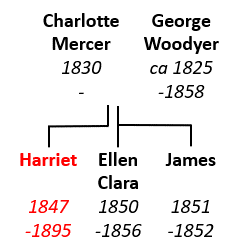 The 1851 Census showed the family in Blackheath, just to the northeast of Wonersh. 4-year-old Harriet retained her Mercer surname while Ellen’s was Woodyer 6. Harriet and Ellen gained a brother James later that year, but within just seven years, the family had been decimated 7.
James died, aged one, in November 1852, followed by 6-year-old Ellen in November 1856, and Harriet’s stepfather George in January 1858 8, 9, 10.
This left just Harriet, coming up to her eleventh birthday, and her 27-year-old widowed mother Charlotte. They moved back in with Charlotte’s father Henry Mercer, with the 1861 Census showing the three of them in the hamlet of Blackheath, , all agricultural labourers despite Henry being 66 and Harriet only 14 11.
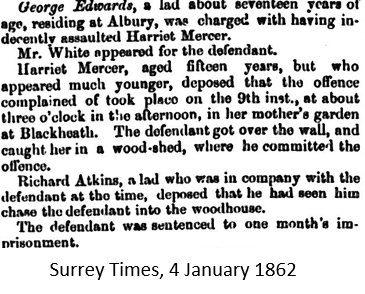 In late December that year, Harriet was subjected to an indecent assault at her Blackheath home. The County Bench at Guildford heard that George Edwards, aged about 17, climbed over the garden wall and assaulted Harriet, for which he received a one-month prison sentence 12.
On Christmas Day 1862, Harriet’s mother Charlotte married carpenter James Bartlett in Wonersh 13. They had twins in June 1865, but both died within a very short time 14.
Change of fortune for Harriet?
The assault and five close family deaths during her life so far must have been difficult for Harriet to deal with. However, Harriet’s prospects appeared to be going in the right direction when, aged 23, she married fishmonger Henry Rogers in July 1870 in Merrow 15. She named her father as George Woodyer, although this was more likely for the sake of appearances on the certificate as she probably did not know who her father was.
The 1871 Census showed Harriet and Henry settled at 30 Quarry Street, Shalford, Guildford with Henry aged 38, considerably older than their marriage certificate stated (32) 16. Henry had been baptised in Guildford in 1837, so he was certainly at least 34, more than ten years older than Harriet 17.
Their first son, George Henry Rogers, was born in June 1874 in the Chertsey Union Workhouse 18. Harriet and Henry would not have been living together in Guildford for George’s birth to have taken place there. Henry was described as a bricklayer’s labourer on the birth certificate – an unusual change, perhaps, from being a fishmonger.
A daughter, Lottie Ethel, was born in November 1876, followed by Claud William Burnett in June 1878, both in the Guildford Union Workhouse 19, 20. On the official birth certificates, their father was given as Henry Alfred Rogers, fishmonger, but Workhouse birth records state that although Harriet was married, both children were illegitimate 21.
More despair for Harriet
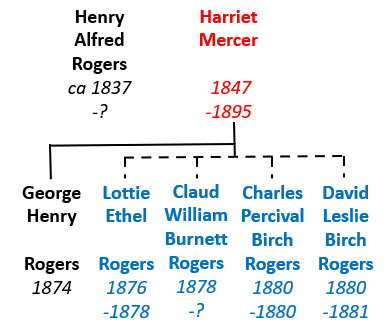 Claud’s birth records are the only two references traced for him. Five months later, Lottie passed away from pneumonia, aged 2, in Blackheath 22. She was noted as the daughter of Harriet Rogers, ‘a domestic servant’, with no mention of any father.
The proof that Henry was definitely no longer in Harriet’s life came with the birth of twins David Leslie Birch Rogers and Charles Percival Birch Rogers in April 1880 in the Guildford Union Workhouse 23, 24.
The Workhouse records confirmed that the twins were Harriet’s third and fourth illegitimate children, and the full truth was revealed two months later when Harriet appeared before the County Bench naming John Burch, a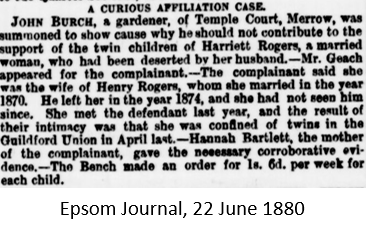 gardener from Merrow, as their father. Harriet said that her husband, Henry Rogers, had deserted her in 1874, and she had not seen him since. John did not deny the allegation, so was ordered to pay 3 shillings (£0.15) per week for the upkeep of the children 25.
The desperate times continued for Harriet when one of her twins, Charles, died in the Guildford Union Workhouse in December 1880, aged 8 months, from bronchitis 26.
She was still an inmate four months later in April when the 1881 Census was taken 27. With her was her one-year-old son listed under the name of Benjamin, rather than his birth name of David. Harriet’s oldest child, George, 6, was living with her mother Charlotte and husband James in Send 28.
Just six days after the Census, her second twin, David, died in the Workhouse from ‘debility from birth’ and ‘whooping cough’ 29.
A brief second marriage
There are no records available to show when Harriet left the Guildford Union Workhouse but in 1887, she married soldier John Clarke in Farnham, possibly bigamously as she was seemingly still married to 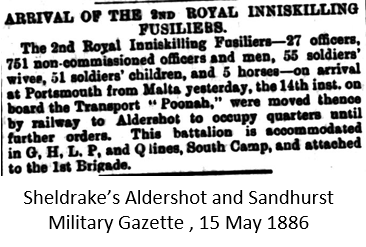 Henry Rogers although he has not been traced since he deserted her 30.
John, over 10 years younger than Harriet, was an Irishman serving with the 2nd Royal Inniskilling Fusiliers based in Aldershot since May 1886 31, 32.
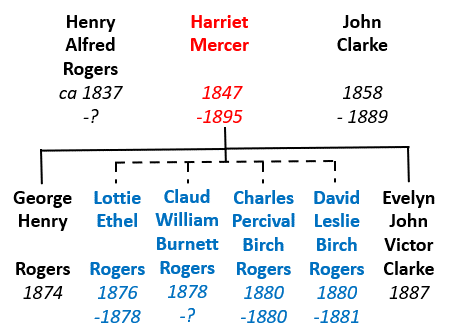 Harriet was pregnant at the time of their marriage, giving birth in July 1887 to son Evelyn John Victor Clarke in Send 33. The family were not together for long, as in December 1888 John’s battalion was posted to India, leaving Harriet and her two sons in England 34. Less than 8 months later, John died in Secunderabad Hospital.
Separation of third marriage after violence
Harriet did not remain a widow for long, with her fateful marriage to bachelor Henry Tickner taking place in Aldershot on 1st November 1890 35. Harriet’s eldest son, 16-year-old George, and her mother Charlotte, were witnesses. Henry, 41, was born in Alfold, Surrey, the youngest of eleven known children for James and Martha Tickner 36.
The 1891 Census just five months later gave an indication of trouble in their marriage. Harriet and bricklayer’s labourer Henry were living near Farnham, but Harriet’s sons George and 3-year-old Evelyn, named as ‘John E’, were with Harriet’s mother Charlotte and her husband almost 15 miles (24km) away in Send 37, 38.
Harriet and Henry did move to Sutton just outside Send, but at the end of 1893, Harriet applied to the Guildford Justices for a separation order from Henry because of his violence towards her. This was granted, with Henry bound over to keep the peace and ordered to pay Harriet 4 shillings (£0.20) a week 39, 40. Harriet and her two sons were by then living with her mother in Send.
Murderous attack at home
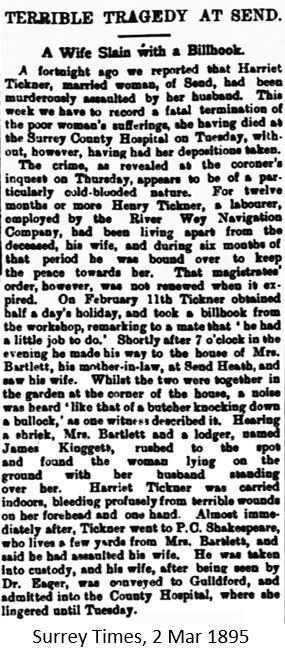 Henry, living about half a mile (1km) away, came most weeks to the house to give Harriet the money. Harriet’s mother Charlotte kept the doors of the house locked as she did not want Henry in the house because of his violent past and threats she had heard him make to Harriet when delivering the money.
When Henry arrived at the house shortly after 7pm on 11th February 1895, Harriet went outside to talk to him, leaving her mother and young son inside. While Harriet and Henry were talking, the lodger James Kinggett arrived home, shaking hands with Henry before going indoors. Seconds later, James and Charlotte heard a shriek from outside. 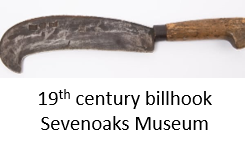 Charlotte rushed out to see Henry bent over her daughter after he had struck Harriet with a billhook, severely injuring her head and hand.
Charlotte pushed Henry over, allowing James to carry Harriet inside to tend to her injuries.
Henry went straight to a policeman living four doors away and admitted what he had done, saying ‘I meant to do for the whole ——- lot’.
The policeman arrived at the house to see Harriet with ‘a wound on her head and blood was flowing down her face’. Her hand had been almost completely cut off.
Harriet initially survived the attack, but barely regained consciousness. She died in Guildford’s Royal Surrey County Hospital 15 days later of ‘inflammation of the brain caused by a fractured skull’.
The trial and verdict
The hearing at the Guildford County Bench on 2nd March 1895 heard that Henry, who worked as a labourer for the Wey Navigation Company, had taken the billhook from the workshop on the day of the attack after asking for the afternoon off, saying ‘he had a little job to do’. Henry, who did not speak in his defence, was committed for trial for ‘wilful murder’.
There was a large gallery for the trial held on 12th June 1895 at the Surrey Assizes in Guildford’s County Hall. Henry pleaded ‘not guilty’ to the charge of wilful murder of his wife Harriet, and spent much of the time hiding his face in a handkerchief 41.
Speaking at the trial, Harriet’s widowed mother Charlotte spoke about Henry’s threats against her daughter, having heard him say he would ‘do for’ his wife. Allegations had been made by Henry’s defence counsel that he had been angered by Harriet having an affair with the lodger James, but Charlotte denied there had been any impropriety. James also refuted these allegations, talking about his good-natured greeting by Henry outside the house just seconds before the attack.
 Another line of defence for Henry came from his sister Harriet Puttock, who said there was ‘insanity’ in their family – two of their sisters had been in asylums while another sister and their mother had suffered with mental problems. However, a past employer of Henry said that he ‘never saw any sign of insanity (in Henry) …. but he was of an excitable disposition’.
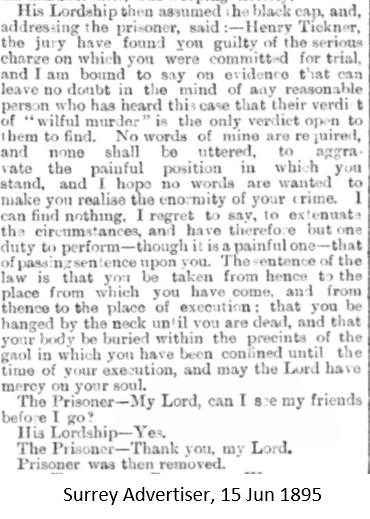
In his summing up, Mr Justice Grantham dismissed both allegations, saying that ‘he failed to see anything which would justify the jury in finding him guilty of the less serious crime (of manslaughter)’. The jury returned a verdict of 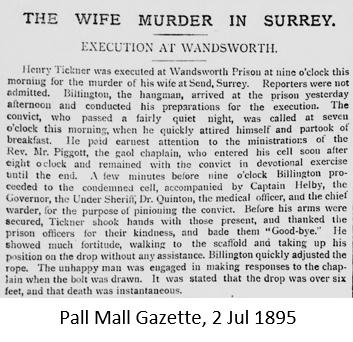 ‘guilty of murder, with a strong recommendation to mercy’, but Mr Justice Grantham pronounced the death sentence for Henry.
A plea for mercy sent to the Home Secretary was overruled, so Henry, aged 45, was hanged on the morning of 2nd July 1895 at Wandsworth Gaol 42, 43.
Harriet’s sons
Harriet’s youngest son Evelyn John would surely have borne lifelong mental scars as he was just 7 years old when he was in the house on the night of the fatal attack on his mother. Being an orphaned son of a soldier, he was accepted in August 1896 at the age of 9 as a full-time resident of the Duke of York’s Royal Military School in Chelsea, London 44.
In August 1901, as a 14-year-old tailor, a skill he would’ve learnt at the school, John enlisted with the Royal Garrison Artillery 45. He served with them for 12 years in the UK and Gibraltar, leaving the Army for unspecified reasons aged 26 at the end of October 1913 at Spike Island, County Cork, Ireland. He has not been traced since then.
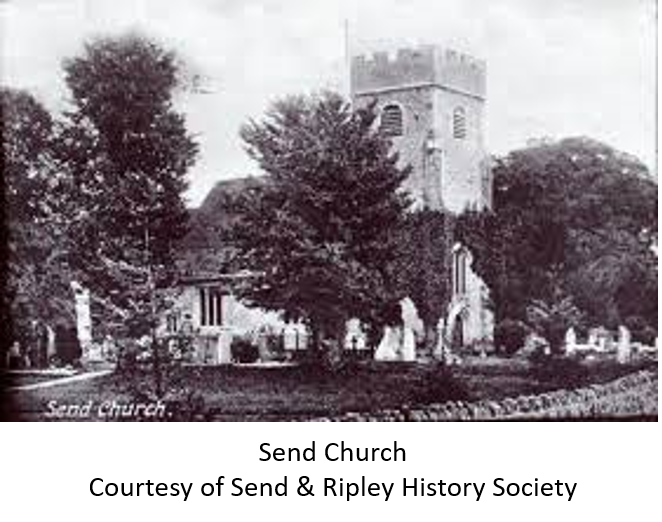 Evelyn John’s elder half-brother George was a railway porter when he married Lilian Mary Pell in August 1894 in Send 46. The couple raised a family in South London where George passed away in 1930, aged 55 47, 48. George’s funeral was at Send St Mary’s church, the same church where his mother was buried 35 years earlier 49.
October 2022, updated December 2025
Edited by Mike Brock
We’d love to hear from you if you are a relative of Harriet, her children, Henry Tickner, or any of the other people featured in this biography. Please contact us by email at spikelives@charlotteville.co.uk
Sources and References
Original Surrey parish records and newspapers are available at the Surrey History Centre, Woking. Digitised records were sourced through Ancestry.co.uk. Newspaper articles were sourced through British Newspaper Archive/FindMyPast.co.uk. A complete list is here Harriet and Benjamin Rogers references
 Spike Lives is a Heritage project that chronicles the lives of inmates, staff and the Board of Guardians of the Guildford Union Workhouse at the time of the 1881 Census. The Spike Heritage Museum in Guildford offers guided tours which present a unique opportunity to discover what life was like in the Casual/Vagrant ward of a Workhouse. More information can be found here