
Subject: Ellen Grist (b 1868 – d 1953)
Researcher: Pauline Sieler
50 years of care in charitable organisation homes for disabled ex-Workhouse orphan
Ellen Grist was just a few weeks old when she was orphaned. Having been born with physical problems as well, she spent all her childhood in the Guildford Union Workhouse, and almost all her adult life cared for by charitable organisations St Peter’s Memorial Home, Woking, and Brabazon Home, Reigate. Despite this, Ellen, as a young woman, was able to work for a short time in domestic service, gaining respect and recommendations from her employers. When she was no longer able to work, Ellen was provided with funding enabling her to stay out of the Workhouse and live in homes for ‘incurables’ for around 50 years.
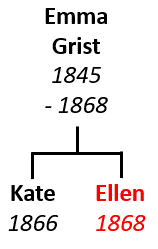 Ellen was born on 14th May 1868 in the Guildford Union Workhouse, the second illegitimate child of Emma Grist and was baptised at Stoke next Guildford’s St John the Evangelist Church 17 days later, while both were still inmates of the Workhouse 1, 2. Ellen had an elder sister Kate who had been born in their mother’s home village of Worplesdon in August 1866 3.
Less than two months after Ellen’s birth, Ellen and Kate’s mother Emma died in nearby Aldershot on 11th July 1868 from scarlet fever, aged only 23 4. Emma had left the Workhouse soon after Ellen’s birth and had gone to Aldershot, possibly to work as a domestic.
However, the sisters were not going to be living together after the loss of their mother. Kate, as an ‘orphan’, was receiving poor relief in the form of financial assistance from the Guildford Union enabling her to stay with relatives out of the Workhouse 5. This did not apply to baby Ellen who became a permanent inmate of the Workhouse 6. There is nothing in available records from that time to indicate that Ellen had a physical problem.
The 1871 Census confirmed this situation. Ellen was a 2-year-old Workhouse inmate while Kate, 5, was living in Worplesdon with their uncle George, his wife Emma and their four children aged between 10 and 2, the youngest born just six weeks after Ellen’s mother had died 7, 8, 9.
Having another child of a similar age, even without physical problems, would have been difficult for George and Emma, especially as they were expecting their fifth in 1871, although they would have received financial assistance for Ellen‘s care from the Union, as they were for Kate 10.
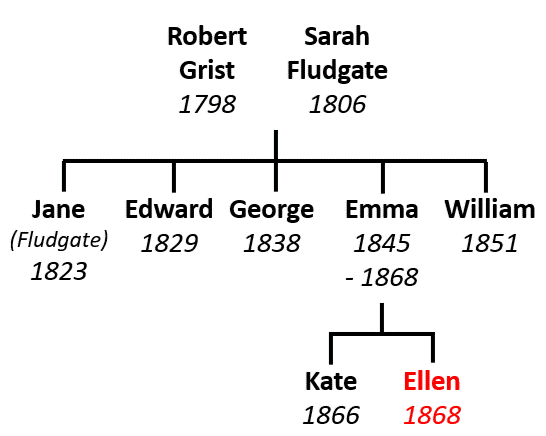 Other relatives of Ellen were all in Worplesdon but also had large families to cope with on farm labourers’ wages – her uncle Edward Grist and wife had five children, her aunt Jane Fenn and husband also had five at home, while the youngest of the uncles, 20-year-old William, was still living with his parents – Ellen’s grandparents – Robert, 72, and 64-year-old Sarah 11, 12, 13. For at least the past four years, Robert had been receiving poor relief for being ‘partly disabled’ or suffering from ‘infirmities’, so caring for a small granddaughter with problems of her own would surely have been beyond them 14.
Ten years later, Ellen was a 12-year-old scholar inmate of the Guildford Union Workhouse 15. It is not known if Ellen, at any time, had lived elsewhere, how much she had seen of her sister Kate and other relatives, or what her state of health was. Kate, now 15, had moved to Guildford where she was working as a domestic servant 16.
St Peter’s Memorial Home, Woking
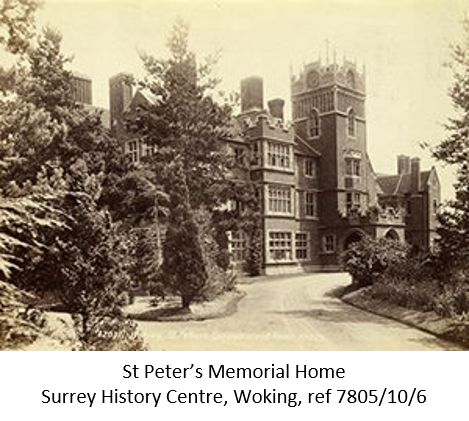 By now Ellen, as well as having a basic education, would have been given training to help her find employment outside of the Workhouse. For girls, this mostly involved learning domestic duties to enable them to become general servants. Ellen did go ‘into service’ at some stage but had to stop because she was suffering from an ‘acute headache’, so in October 1887, she went to live with her aunt Jane in Worplesdon, her mother’s elder sister 17. Her health did not improve, so just before Christmas 1887, 19-year-old Ellen was admitted to the St Peter’s Memorial Home, Woking.
The Home had opened two years previously, run by the Anglican Sisterhood of St Peter to provide convalescent care for ‘incurables’, admitting patients that were refused by other homes 18. Ellen’s admission record is the first found regarding her health, noting that she had a ‘curvature of the spine’. Despite this, Ellen had clearly been a good employee, coming with recommendations and guarantees from two local benefactors, Miss S Dean Pitt, and Miss Adelaide Thrupp of Merrow House.
Ellen remained in St Peter’s until March 1888, when her ward sister wrote that Ellen left ‘quite well from here. Miss Mayo kindly took her into her children’s home for a few weeks until she can hear of a situation’. Mary Mayo was a philanthropist living at Riverdale House, London Road, Dorking who, among her charitable works, paid for the building of a school and church near her home 19. However, if Miss Mayo did help Ellen go back into service, it can only have been for a short time because the 1891 Census showed 22-year-old Ellen to be an inmate of the Brabazon Home of Comfort, Lesbourne Road, Reigate 20.
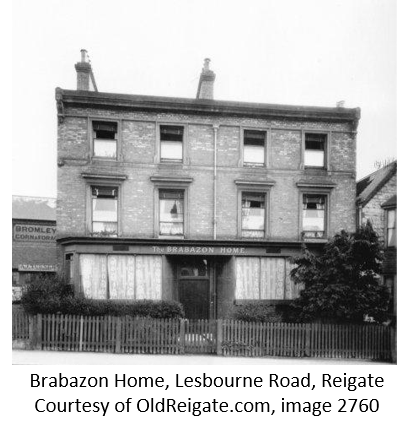 Brabazon Home, Reigate
Like St Peter’s, the Brabazon Home had also opened its doors in 1885, providing medical and convalescent care to members of the Girls Friendly Society suffering from chronic or incurable conditions, and invalids like Ellen who were not eligible for any other hospital other than a workhouse infirmary 21, 22.
Ellen had probably been a member of this Society for some time as it offered young women a network of support and community, helping them avoid exploitation at work. The Home had originally been designed to be shops, so the dining room and sitting room had large front windows looking out onto the street. There were 20 beds available initially for girls and women aged between 14 and 35, with the bedrooms cheerful and bright.
How Ellen’s care was being funded is not clear. In April 1892, the Guildford Board of Guardians received a letter from the Lady Superintendent of Brabazon House requesting a contribution towards Ellen’s maintenance 23. The Guardians resolved to let the matter stand adjourned until the next meeting while enquiries were made to confirm that Ellen was chargeable to Guildford.
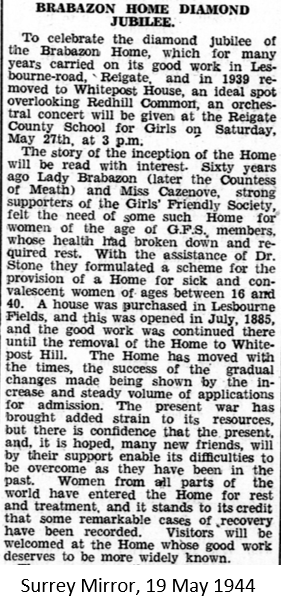 Although no follow-up to the Home’s request was recorded, Ellen was able to remain as a patient of Brabazon House and did so for many years to come. The 1921 Census stated that Ellen had been an ‘invalid from childhood’, perhaps going some way to explaining why she had remained in the Workhouse and not with family in her early years 24.
After Ellen had lived in Brabazon House for around 50 years, the building was closed in 1939, with staff and patients, including Ellen, moved to Whitepost House, Whitepost Hill, on nearby Redhill Common 25, 26.
Ellen was now in her 70s, and in April 1940, the Whitepost House logbook stated that Ellen ‘was becoming increasingly feeble and difficult to nurse. It was feared she would have to be removed’ 27.
Five months later, Ellen became a patient of Redhill’s St Anne’s Hospital where she probably remained for the rest of her life, passing away there on 28th January 1953 from influenza, aged 84 28, 29.
Ellen’s sister Kate
Ellen’s elder sister Kate worked as a domestic servant and cook before she married labourer William John Batchelor in Worplesdon in 1892 30. The marriage certificate named Kate’s father as George Grist, although he was Kate’s maternal uncle who had brought up Kate with his family in Worplesdon 31. Kate named her first daughter Ellen, going on to have a large family 32, 33. In July 1909, Kate died at home in Tonbridge, Kent from heart disease, aged just 42 34.
December 2019, updated October 2026
Edited by Mike Brock
Ellen Grist was in the Guildford Union Workhouse with Agnes Slow, who like Ellen had been admitted as an orphaned baby after her mother died. Agnes was only two years older than Ellen, so the two would have spent their childhood together. Both spent some time at St Peter’s Memorial Home, although not at the same time, but their lives after that were very different.
Agnes Slow: Raised in workhouse, life-changing ‘marriage’ to former convict
We’d love to hear from you if you are a relative of Ellen Grist, or simply enjoyed the biography.
 Contact us by email at spikelives@charlotteville.co.uk
Facebook at ‘Tales from Guildford Workhouse’ Instagram at GuildfordSpikeLives
Sources and References
Surrey parish records and local newspapers are available at the Surrey History Centre, Woking. Girls’ Friendly Society and Brabazon Home records are held at the Women’s Library Archives, London School of Economics. Digitised records were sourced through TheGenealogist.co.uk, FindMyPast.co.uk and Ancestry.co.uk. A complete list is at Ellen Grist reference
 Spike Lives is a Heritage project that chronicles the lives of inmates, staff and the Board of Guardians of the Guildford Union Workhouse at the time of the 1881 Census. The Spike Heritage Museum in Guildford offers guided tours which present a unique opportunity to discover what life was like in the Casual/Vagrant ward of a Workhouse. More information can be found here