
Subject: Edward Eede (b 1870 – d 1956)
Researcher: Debbie Thornton-Grimes
Guildford Workhouse to Army School Musketry Instructor
As a child, Edward John Eede was left by his mother in the Guildford Union Workhouse after the disappearance of his father, but through dedication and hard work, Edward came through this and an indifferent start to his Army career to gain a full education and become a much-respected instructor in the Army’s School of Musketry. His family life saw him married three times, the last time as a 78-year-old.
Early Years
Edward was born on 7th March 1870 in Mile End, east London, the son of hairdresser Edward and Mary Eede née Joyce and was baptised in Stepney’s St Dunstan’s Church, with the family living in nearby Greenwood Street 1, 2. He was the second child, his sister Mary Selina having been born in Stepney in April 1868, just three months after their parents’ wedding in Notting Hill, west London when their father was just 20, five years younger than their mother 3, 4.
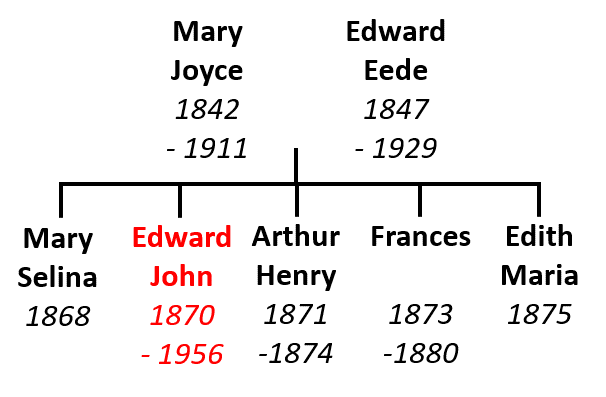 Soon after Edward’s birth, the family were on the move again, with the 1871 Census showing them living at 1 Friary Street, Guildford, the town where Edward’s mother Mary had been born 5, 6. His father was still working as a hairdresser.
Arthur Henry was born there later that year, but he died in February 1874 age 2 from ‘spinal disease’ 7, 8. Two more siblings, Frances and Edith Maria, were born at Friary Street in 1873 and 1875 respectively 9, 10. However, in May 1880, when 7-year-old Frances died from ‘peritonitis’, she was at the home of her widowed maternal grandmother Ann Joyce in St Catherine’s, just to the south of Guildford, with Ann also registering her grand-daughter’s death 11.
A Family Living Apart
The significance of this was made clear by the 1881 Census eleven months later which showed the Eede family had been torn apart. 11-year-old Edward was an inmate of the Guildford Union Workhouse, separate from his mother and two siblings, with his father nowhere to be seen 12.
There are no available records to show when or why Edward was the only one of the three children in the Workhouse. Edward’s older sister, Mary Selina, aged 13, was living in St Catherine’s with their grandmother Ann, while his 6-year-old sister, Edith Maria, was ‘a visitor’ with a family in Betchworth, near Dorking 13, 14. Their mother Mary was working as a cook in a hotel in Petersfield, Hampshire, about 25 miles (40km) away, and still described herself as ‘married’, indicating that she believed her husband to be alive 15.
A Military Career for Edward
Although the reasons for Edward being the only one of the three children to be in the Guildford Union Workhouse are unknown, it would have provided him with some education and training to prepare him for the outside world.
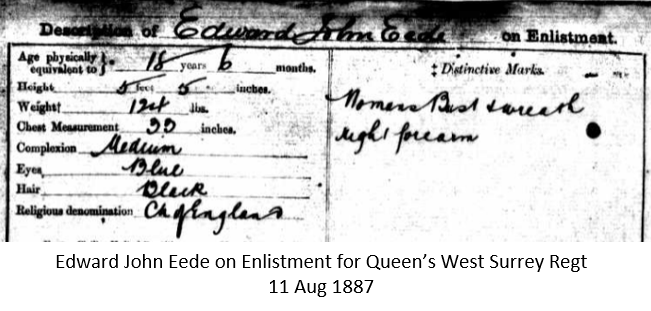 The first record traced for him after he left the Workhouse was his enlistment on 11th August 1887 with the Queens Royal West Surrey Regiment 16. He claimed to be 18, although he was still only 17, a labourer with blue eyes, black hair, medium complexion, 5’ 5” (1.65cm) tall, weighing 124lb (56kg). He also had tattooed on his right forearm a ‘Womans Bust & wreath’. Edward signed the form, indicating a degree of literacy probably gained from his time in the Workhouse.
Edward had a somewhat inauspicious start to his military career. Just over two months later, in Belfast on his first posting, he was ‘admonished’ after being found drunk in town late one night, and the following year spent a month in a Dublin hospital after contracting gonorrhoea. He was promoted to sergeant in August 1890 but was twice ‘severely reprimanded’ for neglect of duty in Aldershot in October 1890 and November 1891. However, he had continued his education in the Army, receiving a 3rd class certificate in December 1887 followed by a 2nd class one in October 1889, the mandatory requirement for his promotion to sergeant. He also qualified as a gymnastics instructor in July 1891.
“Marriage”
Although Edward may have lapsed in some of his military duties, his personal life seemed to be on the up as he married ‘spinster’ Elizabeth Collins in Aldershot’s Parish Church on 14th December 1891 17. His marriage record noted his father as a barber, hinting that he was still alive, despite his mother Mary giving her status as ‘widow’ in the Census earlier that year 18.
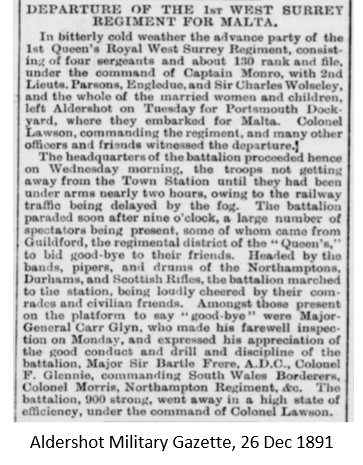 Generally, soldiers marrying was frowned upon, with permission needed from the Army before a wedding could take place 19. Just six days before his marriage, Edward had extended his Army term of service to 12 years 16. On Christmas Eve, Edward was part of an advance party to be sent to Malta consisting of three other sergeants and about 130 rank and file of the 1st Queens Royal West Surrey Regiment, along with the ‘whole of the married wives and children’, therefore including Edward’s new wife Elizabeth 20.
In October 1892, the Regiment was moved to Dinapore, now known as Danapur, in India. Edward’s wife Elizabeth suffered from ill-health there, so he sent her home to England. Edward gave Elizabeth, who was living in Guildford working in service, a monthly allowance. However, while still in India, Edward heard something about Elizabeth that caused him to discontinue the allowance.
Edward’s regiment arrived back in England in March 1894, and he immediately went to Frimley’s St Peter’s Church to verify what he had been told. There he found the marriage record from December 1887 of his wife to John Chatt 21. He took a copy of the certificate to confront Elizabeth which she at first denied – she was named on it as ‘Sarah Elizabeth Collyer’ rather than ‘Elizabeth Collins’ when Edward married her – but she then admitted it was true, saying she ‘did not care whether Chatt was alive or not’.
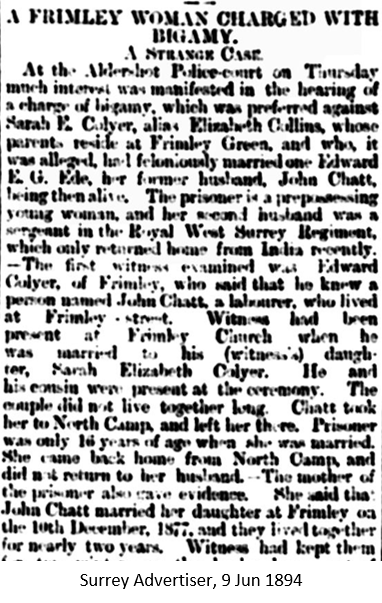 Sarah Elizabeth was arrested for bigamy, and at the trial, it was revealed that she had a son with John Chatt, although he had only lived for a few days 22, 23. Following the child’s death, Sarah said that she had left her husband after he began using threatening behaviour against her. She then met Edward who was, of course, unaware of her situation. When he proposed and told her about travelling to India with him, Sarah told the court that her husband (John Chatt) said she ‘was free’, so she believed that she thought she could do as she had.
The court was lenient because of her husband’s threats, so the judge sentenced Sarah to just 21 days hard labour 24.
New Marriage and New Beginning
Edward went back to his regiment in Kent and just over a year after the trial, 25-year-old Edward married Rachel Emily Calvert on 5th August 1895 at Hougham, just to the west of Dover 25. Rachel was from a military family, born in March 1875 in Colombo, Ceylon (now Sri Lanka) where her father, Henry Buchanan Calvert, was serving in the Royal Artillery 26.
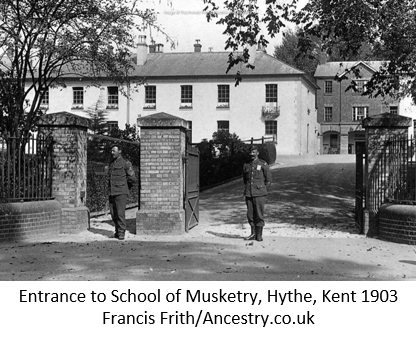
The Royal West Surrey Regiment were in Woking when Edward and Rachel’s first child Henry Edward was born in June 1896, just before Edward changed the course of his military career by transferring to the School of Musketry in Hythe, Kent, 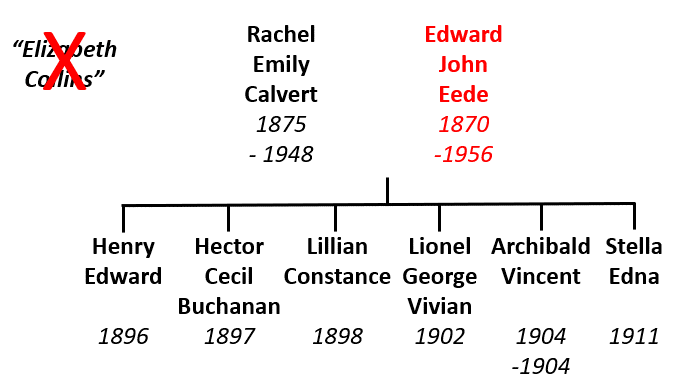 where he became a third-class instructor 16.
Two more children for Edward and Rachel quickly followed – Hector Cecil Buchanan in June 1897 and Lilian Constance in August 1898, both born in Hythe 16, 27. There were further births after the turn of the century – Lionel George Vivian in October 1902 and Archibald Vincent in August 1904, although he only lived for nine days.
Rising up the Ranks
 By 1902, Edward had risen to the rank of Quartermaster Sergeant Major Instructor. Two years earlier, he had gained a 1st class certificate of education, not bad for a boy who started his independent life in the Guildford Union Workhouse.
Edward was serving a 21-year term in the Army, so in August 1908, his time in the Army and the School of Musketry came to an end at the age of 38 – or 39 as his record stated, the extra year he had added when he signed on back in 1887 still standing. Despite the rocky start to his military career, Edward’s behaviour was recorded as ‘exemplary’ and he had ‘committed no offence of a civil or military character for the last 17 years’.
Army life never too far away
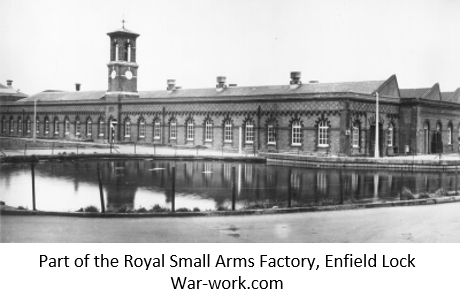 After leaving the Army, Edward remained in a military environment, moving to north London where he worked as a messenger at the Royal Small Arms Factory in Enfield. The 1911 Census showed Edward, his wife Rachel and their children at 93 Standard Road, Enfield, just a short walk from the factory 28. Less than six months after the Census, Rachel gave birth to Stella Edna, their sixth and final child 29.
Edward’s knowledge of firearms was clearly useful, and by the time of the outbreak of World War 1 in August 1914, he was a ‘store keeper’ at the factory. Despite being 44, Edward re-enlisted on 9th September for the Special Reservists at the School of Musketry in Tidworth, Wiltshire 16.
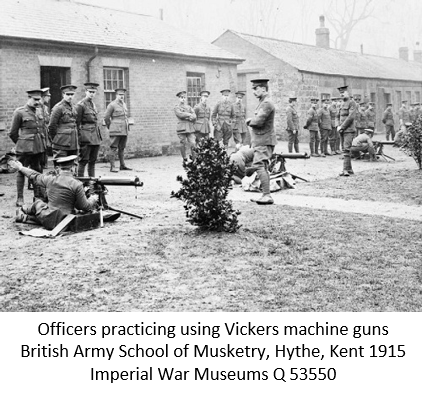 Edward spent three months at Tidworth before being transferred to Hythe where he remained throughout the War in his old role as a Quartermaster Sergeant Major Instructor. His service ended in April 1919, five months after the Armistice, and as before his character on discharge in 1919 is described as very good.
Edward leaves the family home
Edward returned to Enfield, but things were not the same, with the 1921 Census showing that Edward and his wife Rachel were no longer together. 51-year-old Edward was lodging with a widow and her son in Ordnance Road, just around the corner from the old family home in Standard Road 30. He was back at the Royal Small Arms Factory, working as a machine-gun examiner.
Meanwhile Rachel, 46, had moved across London to just south of the River Thames in Blackfriars Road, living with three of their children – Hector, a 24-year-old jeweller’s assistant, Lionel, a hotel waiter aged 18, and 9-year-old Stella 31. Their eldest son, now known as Harry, rather than Henry, had been in the Army through much of World War 1 and was in Ireland serving with the Suffolk Regiment 32, 33. Their other daughter Lilian had married on the Isle of Wight in 1919 34.
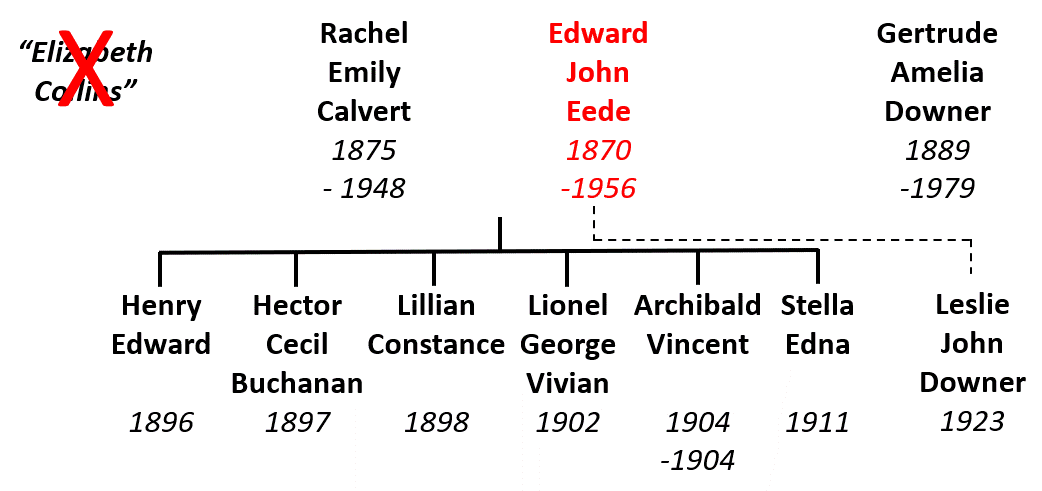 What had caused the family separation is unknown although both Edward and Rachel described themselves as married on the 1921 Census. However, in June 1923, Edward became a father again at the age of 53 when Gertrude Amelia Eede, formerly Downer, gave birth to son Leslie John Downer Eede 35. Leslie was born at home, 45 St Martin’s Road, Edmonton, very close to Enfield with Edward still working at the Royal Small Arms Factory as a store keeper.
The birth certificate clearly stated that Edward and Gertrude were married, but this was untrue – divorce was uncommon and expensive at that time. Gertrude, almost 20 years younger than Edward, was born on the Isle of Wight in December 1889 36. By the time of the 1921 Census, spinster Gertrude was living close to Edward in Enfield, working as a housemaid 37.
Following their son’s birth, they remained in north London until around 1931, before moving to the Isle of Wight 38. The 1939 Register showed them living as husband and wife at Walpan Cottages, Chale, a short distance from where Gertrude had grown up 39, 40.
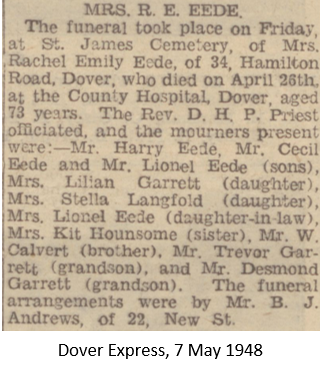 At this time, Edward’s actual wife Rachel was living in Dover with their youngest daughter Stella 41.
Rachel passed away on 26th April 1948, aged 73 with the death certificate recording her as the ‘wife of Edward John Eede, an Army Pensioner’ 42.
All of Edward and Rachel’s five surviving children attended her funeral, but Edward himself did not 43.
Just 27 days after the funeral, 78-year-old Edward formalised his relationship with Gertrude, 58, by marrying her in the Isle of Wight, almost exactly 25 years since the birth of their son Leslie 44.
After nine years of marriage but at least 33 years together, Edward John Eede passed away at their Walpan Cottage home on 16th October 1956 at the age of 86 45. Gertrude outlived Edward by 23 years, dying in 1979, aged 89 46.
Postscript – Edward’s parents
The abandonment of Edward’s family by his father sometime before 1881 saw Edward senior disappearing, seemingly without trace.
Edward junior’s mother Mary died in January 1911 in Guildford 47.
However, after vanishing from official records for around 45 years, Edward senior finally resurfaced in 1920 when he married Caroline Williamson in Bethnal Green, east London, the area in which he had been born 48, 49.
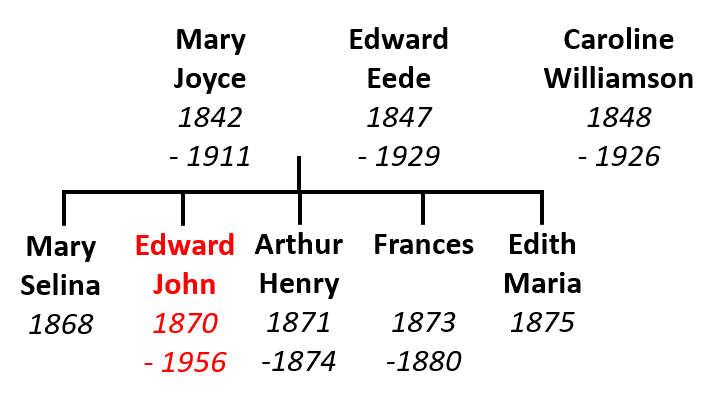 Caroline, from Ridgmont, Bedfordshire, has not been traced since the 1871 Census when she was living with her family in Clerkenwell, close to Bethnal Green, while Edward disappeared after the baptism of his daughter Edith in September 1875, so perhaps Edward and Caroline were together, wherever that may have been, from that time 50, 10.
In 1921 Edward senior, a retired hairdresser, and Caroline, both 74, were living at 28 Shipton Street, Bethnal Green 51. In the mid-1920s they moved close to Bishop’s Stortford, Hertfordshire where Caroline died in 1926, followed by Edward in February 1929 52, 53, 54.
March 2023, updated August 2026
Edited by Mike Brock
We’d love to hear from you if you are a relative of the Eedes, and especially if you have any information on Edward Eede senior’s mysterious disappearance and marriage to Caroline Williamson!
 Please contact us by email at spikelives@charlotteville.co.uk, or on Facebook at ‘Tales from Guildford Workhouse’
Sources and References
Surrey parish and Guildford Union records are available at the Surrey History Centre, Woking. Digitised records were sourced through Ancestry.co.uk and FindMyPast.co.uk. A complete list of references may be found at Edward Eede references
 Spike Lives is a Heritage project that chronicles the lives of inmates, staff and the Board of Guardians of the Guildford Union Workhouse at the time of the 1881 Census. The Spike Heritage Museum in Guildford offers guided tours which present a unique opportunity to discover what life was like in the Casual/Vagrant ward of a Workhouse. More information can be found here