
Subject: Edward Turner (b 1799 – d 1887)
Researcher: Margaret Rose
Gamekeeper, publican, farm bailiff, gardener – all and more in long career of Sussex man
Edward Turner, aptly named perhaps because of his ability to turn his hand to a wide variety of jobs including gamekeeper, publican and farm bailiff, raised two children in Dorking with his wife Peggy before spending his final years as a Guildford Union Workhouse inmate.
Edward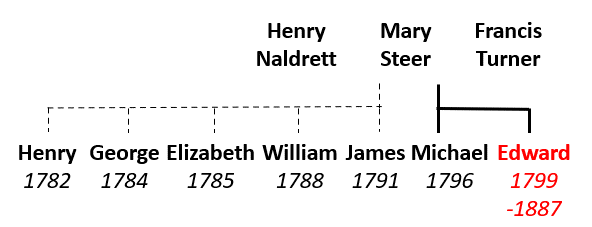 was born in Warnham, Sussex, a village just north of Horsham and baptised at the parish church in May 1799 1. He was the second son of Francis, a farmer, and Mary Turner. He had five older step-siblings from his mother’s first marriage 2, 3, 4.
Edward has not been traced again until his marriage, aged about 33, to spinster Peggy Cave from Rickmansworth, Hertfordshire, which took place on 5th June 1832 at St George’s Church, Hanover Square, Westminster 5.
Both Edward and Peggy were ‘of this parish’, indicating that they had moved to London, probably for work. The witnesses to their wedding, William and Charlotte Bawden, give a clue as to why Peggy at least may have been living in London. Charlotte, 13 years older than Peggy, was also from Rickmansworth, so she may have brought Peggy the short distance to London to be their servant 6-9.
Back to Sussex
H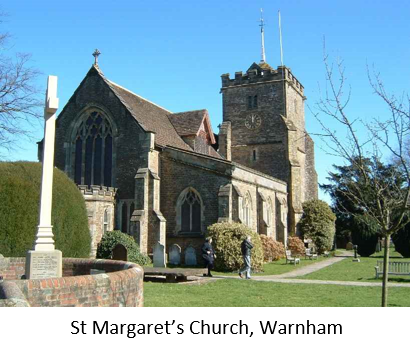 owever, Edward and Peggy did not remain in London, as shortly after their marriage and with Peggy heavily pregnant, they were in Edward’s home village of Warnham. Twins Mary and Ann were born in July 1832, although neither child survived more than a few days 10, 11.
Edward’s occupation on the twins’ baptism record was ‘late gamekeeper’, so it would seem unlikely that Edward had been living in central London for any length of time, or perhaps, at all.
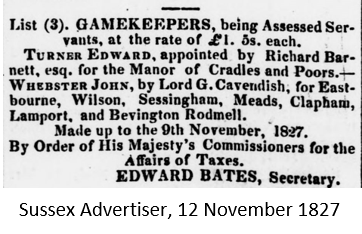 He had been gamekeeper at the Warnham estate of Richard Barnett from at least 1824 until the end of the decade, possibly until the main house burnt down in 1830 12, 13.
A move to Dorking
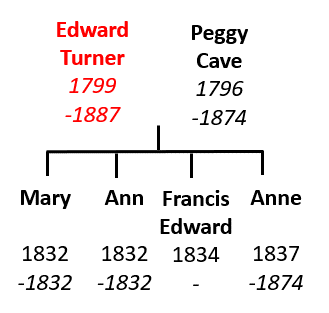 Edward and Peggy’s son Francis Edward was born in 1834 in Holmwood, near Dorking, Surrey, about 10 miles (16km) north of Warnham 14. Edward was now a publican.
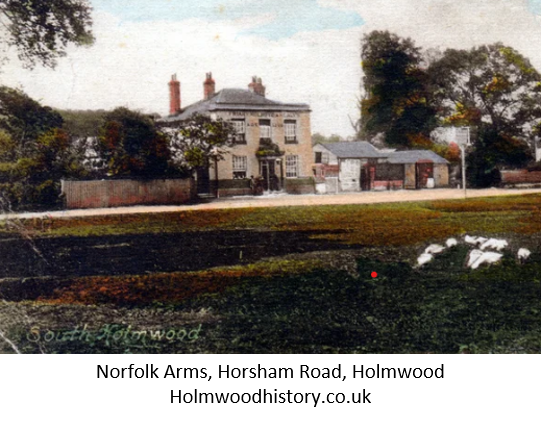 A daughter, Anne, followed three years later with the 1841 Census showing the family living at the Norfolk Arms, Holmwood 15, 16. With them was Edward’s 81-year-old widowed father, Francis Turner.
By 1851, Edward and Peggy were no longer at the Norfolk Arms, but living in different homes on the Horsham Road, Holmwood 17, 18. Edward was a lodger working as a messenger and Peggy was a ‘nurse’, probably a temporary live-in position looking after a new-born. Their son Francis, 17, a carpenter, was a visitor in Brighton 19. Their 14-year-old daughter Anne was visiting her widowed ‘uncle’ William Bawden in London, one of the witnesses to her parents’ wedding 8.
In November 1858, Edward’s son Francis married Frances Pronger at the same church as his parents 26 years earlier, St George’s in Hanover Square, Westminster 20. According to the marriage certificate, Edward had become a farmer.
Three years later, in 1861 Edward and Peggy were living with in Reigate with their son 21. 60-year-old Edward’s occupation was given as ‘farm bailiff’, and Peggy was no longer working. In those days a bailiff would have been overseeing work and labourers on an estate farm, as well as keeping an eye out for poachers 22.
By 1865, Edward’s son Francis and his family had moved down to Keymer, to the north of Brighton, where his wife’s family were based, before living in Lambeth, South London by 1871 23, 24.
Edward’s daughter Anne had married confectioner and cook William Coles in 1863, initially settling in Gravesend, Kent, then moving to Farnham, Surrey, around 1868 25, 26, 27.
Peggy and Edward end their days in Surrey
Either Edward’s son’s move away from Reigate, or his daughter’s move to Farnham may have prompted Edward and Peggy to move about 15 miles (24km) west from Reigate to White’s Hill, East Horsley, in the district of the Guildford Union. The 1871 Census showed Edward, well into his 70s, working there as a gardener 28.
Daughter Anne passed away in April 1874 from scarlet fever shortly after giving birth to her sixth child in Scotland, where she and her family had moved to 29, 30. Edward was still working as a gardener at that time.
Six months later, after more than 42 years of marriage, Edward’s wife Peggy passed away in November 1874, and was buried at East Horsley’s St Martin’s Church 31.
Edward was now alone. His son Francis was in Lambeth, and then in Chatham, Kent 32. Edward’s only other immediate relative was his elder brother Michael, who had remained in their birthplace of Warnham, Sussex throughout his life, having been the Parish Clerk and Sexton for half a century 33.
With nobody to look after him, it seems likely therefore that Edward would have been admitted to the local workhouse in Guildford not too long after Peggy’s death. The 1881 Census showed him to be an inmate there, a widowed farm bailiff 34.
I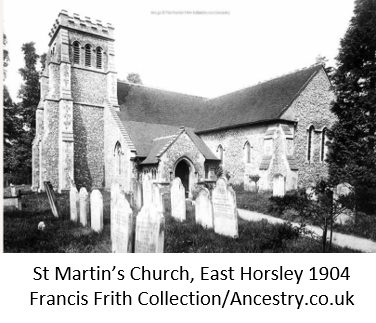 t’s not known why Edward was not ‘removed’ by the Guildford Union to the Horsham Workhouse – as the parish in which he was born that Union would in law have been responsible for him – or if Edward remained in the Guildford Union workhouse from before 1881 until his death on 2nd August 1887 at the age of 88 from ‘Decay of Age’ 35. He was buried three days later, like his wife Peggy at St Martin’s Church, East Horsley 36.
January 2023, updated May 2026
Edited by Mike Brock
We’d love to hear from you if you are a relative of the Turner family. Please contact us by email at spikelives@charlotteville.co.uk
Sources and References
Surrey parish records and newspapers are available at the Surrey History Centre, Woking. Digitised records were sourced through FindMyPast.co.uk and Ancestry.co.uk. A complete list of references is at Edward Turner references
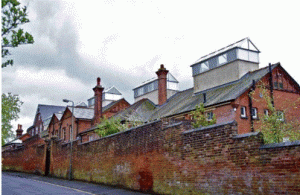 Spike Lives is a Heritage project that chronicles the lives of inmates, staff and the Board of Guardians of the Guildford Union Workhouse at the time of the 1881 Census. The Spike Heritage Museum in Guildford offers guided tours which present a unique opportunity to discover what life was like in the Casual/Vagrant ward of a Workhouse. More information can be found here